US-based Citi reported its best quarterly revenue in a decade in its Q2 2026 results, largely driven by the bank’s Services division, which contains Citi’s cross-border business.
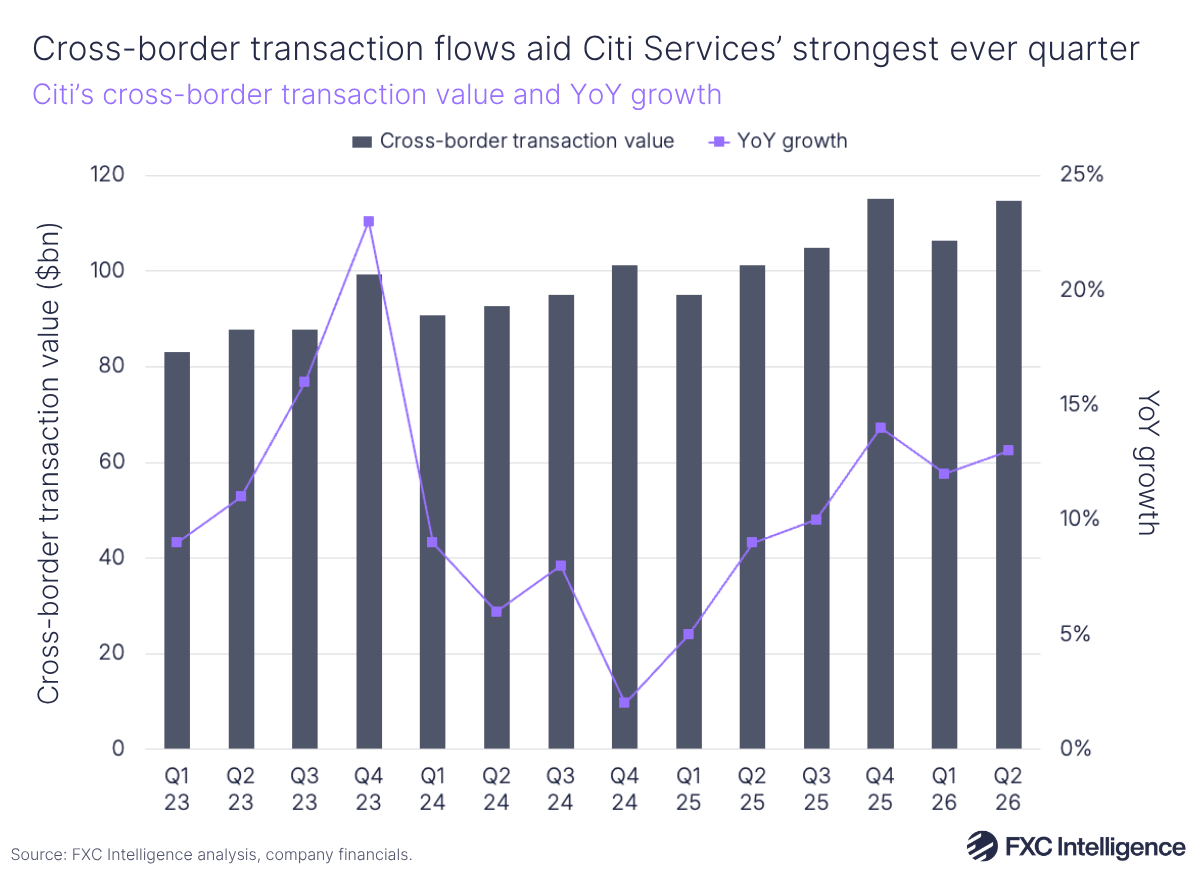
Citi saw its cross-border transaction value increase 13% YoY to $114.6bn in Q2 26 – its second-highest ever quarterly total – which it attributed to clients increasingly leveraging its global network. This growth supported the strongest ever quarter for Citi’s overall Services division, which saw revenues grow 18% to $6.4bn and accounted for 26% of Citi’s overall revenue of $24.8bn in Q2.
Citi’s Treasury and Trade Solutions (TTS) unit, which sits under Services, also drove growth, seeing revenue rise 18% to $4.7bn. TTS net-interest income rose 20% to $3.5bn as average TTS deposits also grew 19% to $852bn. TTS non-interest revenue, which accounts for the majority of Citi’s payments business, saw 13% YoY growth to $1.2bn. Meanwhile, Securities Services revenue, which makes up the rest of Services, increased 16% YoY to $1.6bn.
While Citi enjoyed strong growth that outperformed expectations, it noted that conflict in the Middle East continued to impact global growth and had contributed to higher levels of inflation, an ongoing headwind for the bank. Despite this, CEO Jane Fraser said its corporate clients had shown “real resiliency” and “a proven adeptness of managing the complex environment”, enabling Citi and its clients to offset geopolitical challenges.
Citi continues to integrate AI across its businesses and functions, with Fraser explaining that “nine out of 10” of its people are now using Citi’s AI tools to increase productivity and reduce the time it takes to bring new products to market. She also reiterated that the bank views disrupting technologies, including AI, blockchain and digital commerce, as opportunities to gain a new competitive edge; with AI “opening up many new vectors of growth” in particular. This strategy aligns with the plans Citi outlined during its investor day in May, with AI automation set to feature strongly in the bank’s ongoing transformation.