

dLocal surpassed $1bn in annual revenue in 2025 on the back of strong volume growth and the company’s diversification strategy. We spoke to CFO Guillermo Lopez Perez about what drove the company’s earnings in 2025 and its core value proposition as it continues to scale.

dLocal surpassed $1bn revenue in 2025 on the back of strong volume growth across its core segments. The Uruguay-based payment processor beat its own growth estimates, seeing revenue rise 47% to $1.1bn while total payment volume (TPV) increased by 60% to $41bn. Investors responded positively, with the company’s share price rising 9% at close the day after it announced its results (compared to the prior day’s closing price).
dLocal’s success is built on its network enabling payments for merchants across key emerging markets in Latin America, Africa and Asia, as well as its ability to retain and expand its existing customers over time. The company noted its TPV retention reached 158% in 2025, while net revenue reached 145%, and it has grown its TPV at an 82% CAGR since 2020. It has doubled the number of markets it processes payments in over the last five years to 44 and significantly expanded its support for alternative payment methods and local rails.
Now, the company is focusing on new avenues for growth. It is building strong traction with merchants across verticals such as travel, crypto, gaming and AI, while applying for licences to expand into new markets. It has also launched a full suite of stablecoin solutions; buy now, pay later solution Fuse; and virtual accounts, as well as having new card-present offerings in the pipeline. While some of the innovations the company is targeting won’t materially impact it in the short term, it is making steps to capture its own share of multibillion-dollar opportunities in the future.
To find out more about dLocal’s key drivers in 2025 and its strategic priorities going forward, we spoke to dLocal CFO Guillermo Lopez Perez.
dLocal’s key revenue drivers in Q4 and FY 2025
Daniel Webber: What were the drivers of dLocal’s strong volume and revenue growth in 2025?
Guillermo Lopez Perez:
2025 was a very strong year for us. We reached record levels in volume and revenue. For volume we reached $41bn, which represents a 60% year on year growth. The nice thing is, if you look at the quarterly reports, you see it accelerating throughout the year.
Revenues follow a similar trend, and then we crossed $1bn in 2025. So we’re very happy about the results in 2025. It demonstrates that we are, at the end of the day, adding value for our merchants, and there’s a lot of opportunity in emerging market payments, which is where we tend to talk to investors all the time.
I think it’s the fifth quarter with more than 50% YoY growth, which is exceptional from that point of view, and in Q4, close to 70% YoY growth. In terms of drivers, the nice thing is that it was very broad. If you look at countries, verticals and merchants, the main verticals were e-commerce, remittances, on-demand delivery and ride-hailing, which performed very strongly.
Obviously, our top three markets – Brazil, Mexico and Argentina – did very well from a volume and revenue perspective. But we can see all the markets also growing very healthily, including Colombia, South Africa and Chile.
The majority of the growth comes from current established merchants and that continues to be the case. That’s the business model that we have, but we are seeing that we’re increasing our share of wallet, which is critical for us.
We’re adding new countries for them. We’re adding new payment methods for them. So again, very broad-based [growth] from a country, payment method, vertical and merchant perspective.
dLocal revenue and volume surges in 2025
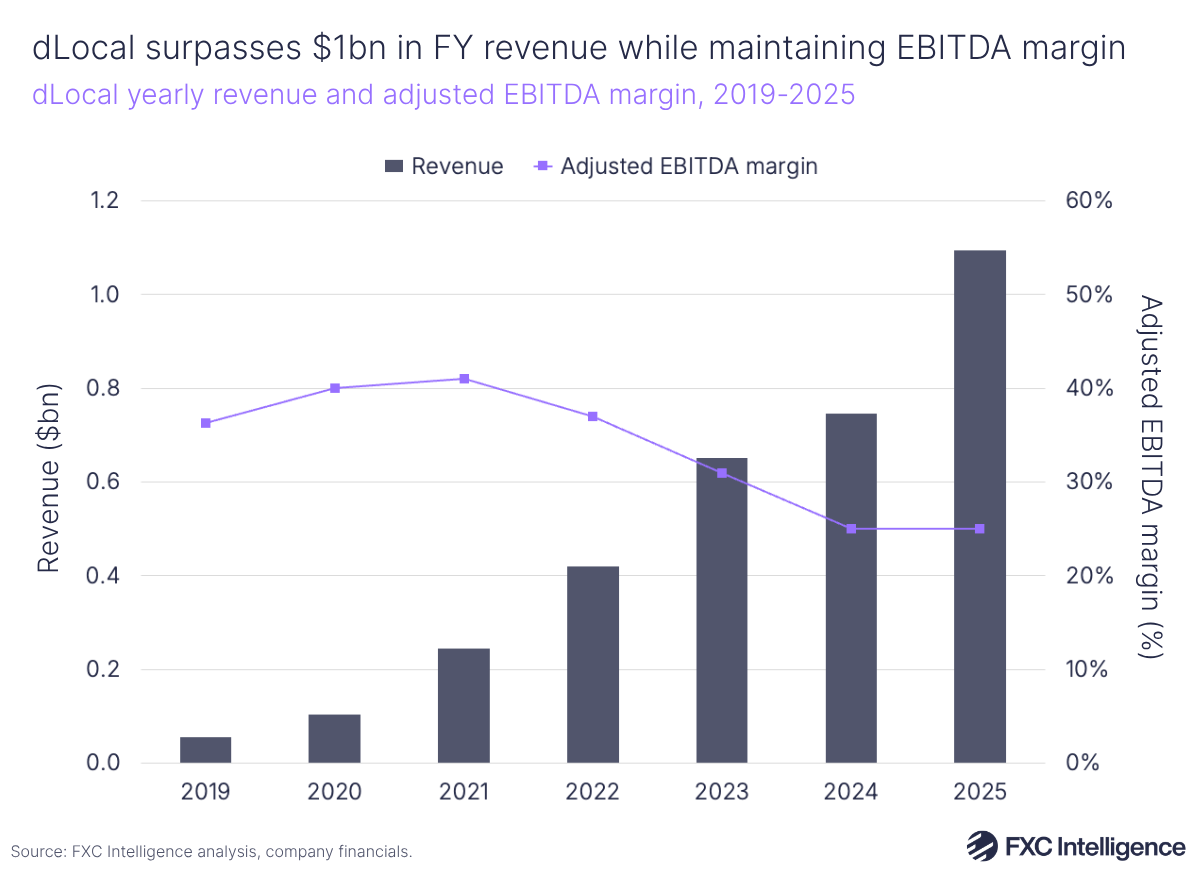
dLocal’s revenue grew 65% in Q4 2025 to $338m, driving 47% revenue growth to $1.1bn for the full year. This surpassed the company’s high-end guidance for the full year and was a significant improvement on growth in 2024.
Gross profit rose 37% YoY to $403m in 2025 while adjusted EBITDA rose 47% to $278m, driving an EBITDA margin of 25%. Based on the company’s revenue and volume for the year, dLocal’s take rate in 2025 was 2.68%, down from 2.92% in 2024.
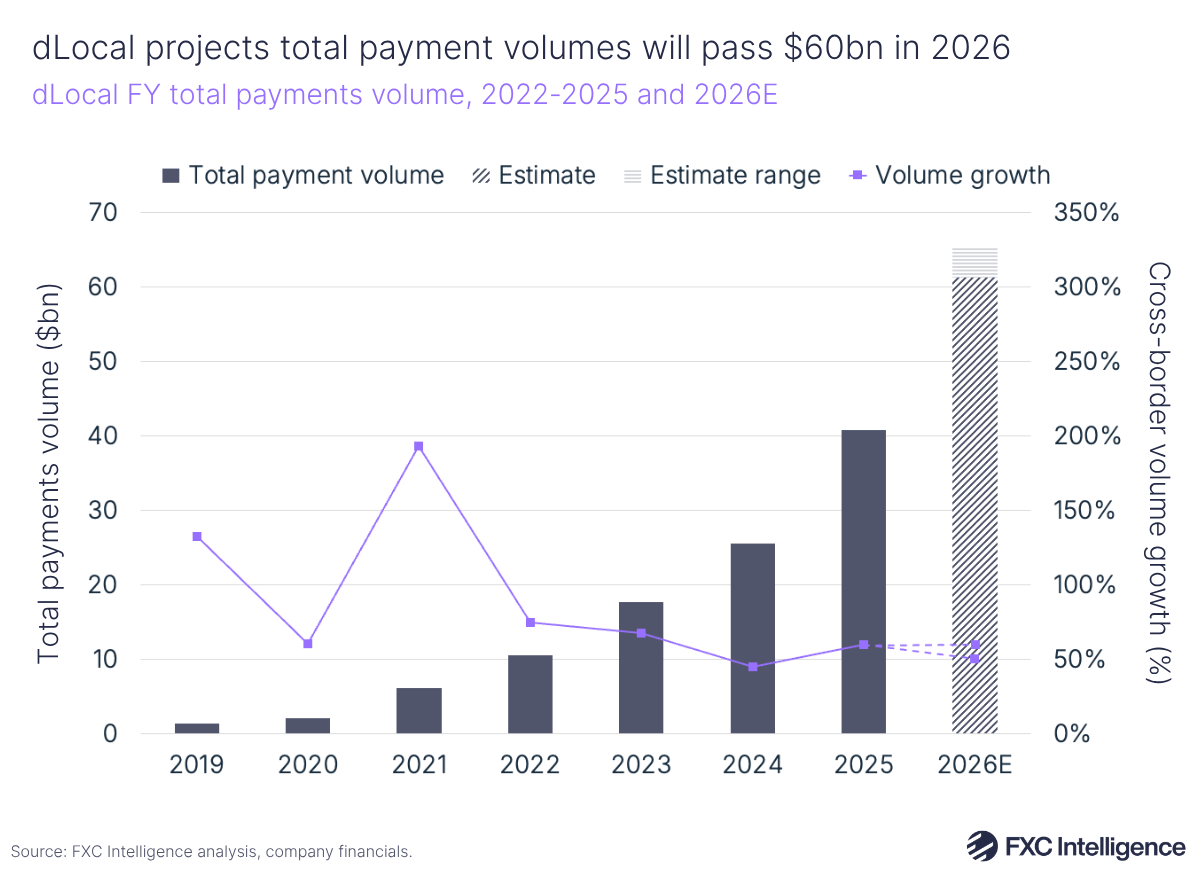
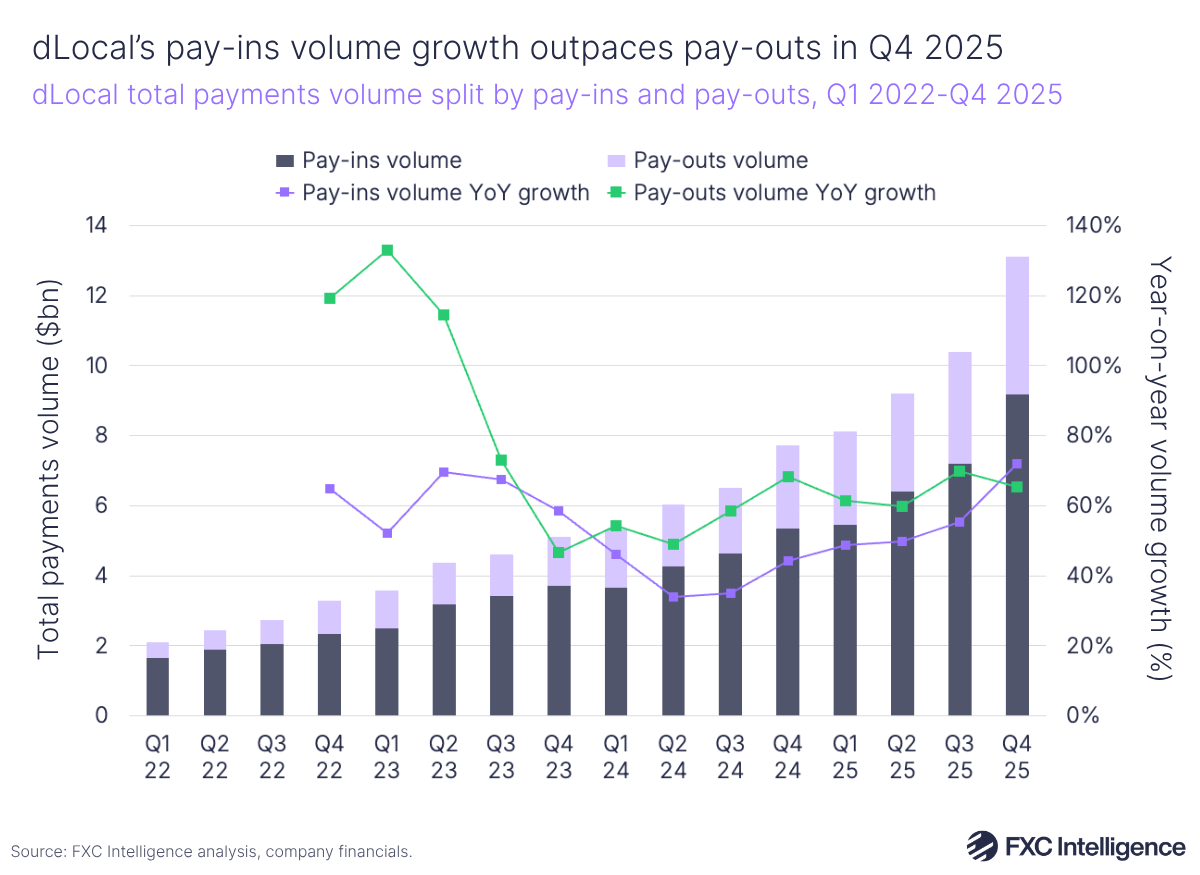
dLocal’s total payment volumes – which comprise both local and cross-border payments – rose by 70% YoY in Q4 2025 to $13.1bn, contributing to dLocal’s 60% YoY TPV growth for the full year. The company is now guiding that in 2026 it will see total payment volumes rise by 50-60%, which would see its TPV surpass $60bn.
How dLocal is growing with customers as they scale
Daniel Webber:
As you keep growing, particularly with existing big merchants, that obviously has an impact on take rates. How are you thinking about that as your customers scale?
Guillermo Lopez Perez:
We get that question a lot, but the reality is we don’t manage on take rates. In one dimension, you have a lot of potential from a volume perspective as you scale up with these merchants. You move into new geographies and new markets with new payment methods. We make sure that the volume that they bring to us is accreted from a gross profit perspective. That’s the opportunity. That’s the building block. And then, as the volume grows with them, obviously, as in all payments, you offer discounts.
So that has an impact on the take rate at the end of the day. But also as they launch into new products or businesses, there’s a mixed component as well that we don’t control. At the end of the day, whether we have more local-to-local or new payment methods that have a lower take rate or payouts that are structurally also lower take rate than pay-ins, we see that type of margin compression that you’re talking about.
If you think about what’s the main driver, the two main drivers are the ones that I discussed, which is mix and volume-based discounting as the volumes ramp up with these merchants.
Cross-border remains significant driver of dLocal’s volumes
Cross-border remains a significant driver for dLocal’s overall volumes. In Q4 2025, cross-border TPV grew by 60% YoY to $6bn, accounting for 46% of TPV overall, driven by dLocal’s ecommerce, remittances and financial services segments. Having said this, this was the first time since Q4 24 that cross-border had accounted for less than half of TPV and the company also saw faster growth in local-to-local volumes in Q4 25, which rose 80% YoY to $7.1bn on the back of growth in ecommerce, on-demand delivery and ride-hailing services.
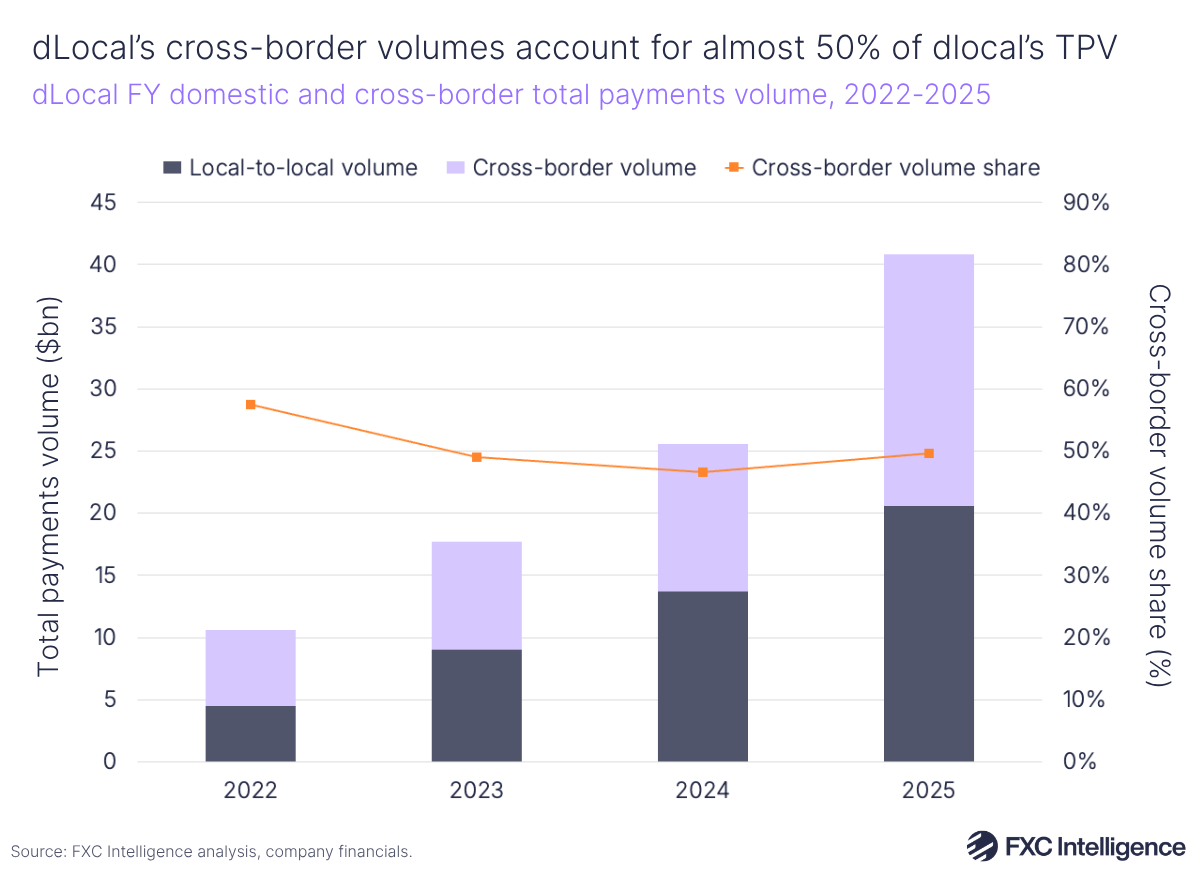
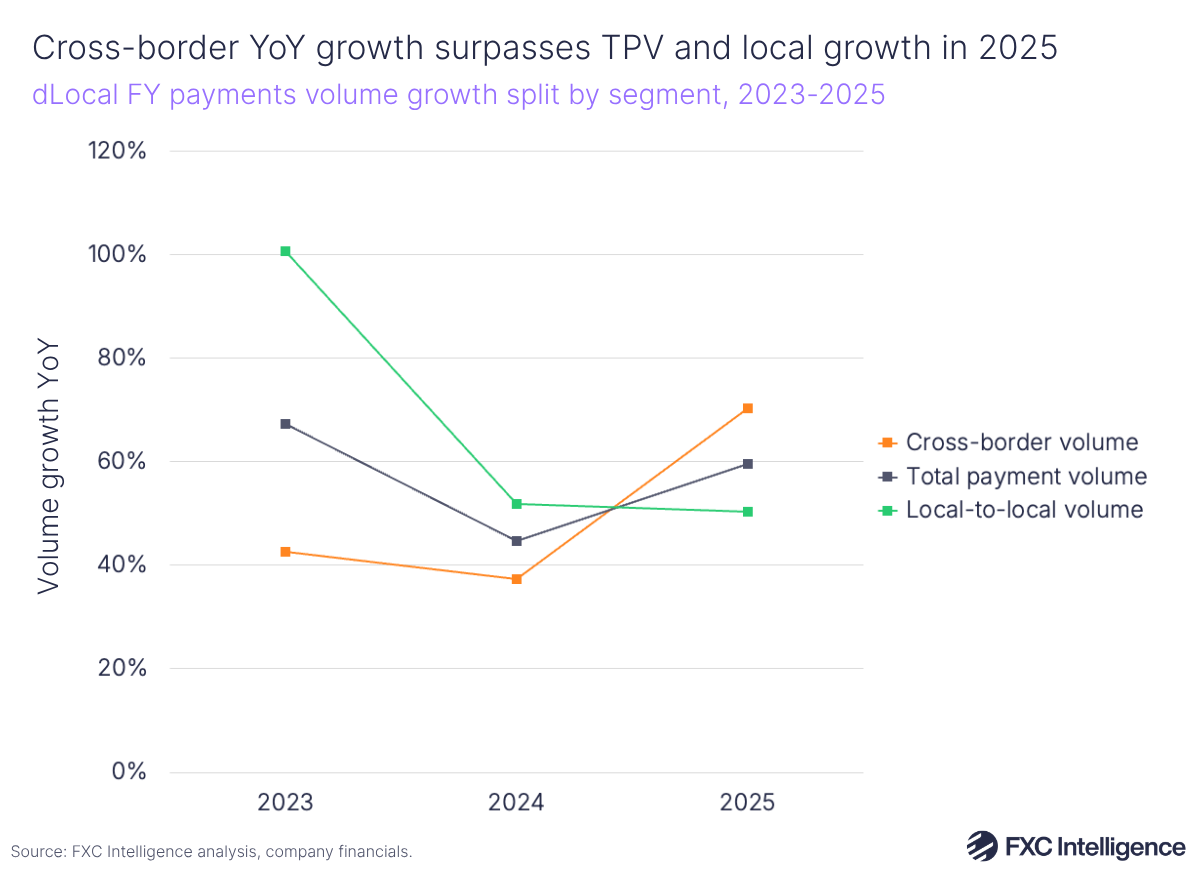
Across the full year, however, cross-border volumes grew by 70%, faster than 50% growth for local TPV and 60% TPV growth overall. Cross-border accounted for 50% of volumes, up from 47% last year, highlighting the continued significance of cross-border payments for dLocal’s customers.
dLocal’s merchant-led approach and core value proposition
Daniel Webber:
In terms of geographies, how do you think about which of these to focus more on and grow into?
Guillermo Lopez Perez:
I wouldn’t say focus on. When we have a merchant that is in need of expanding payments, and it’s in a market that we’re in, we’ll go with them. At this point in time, we’ve reached a level in which we’re present in all the markets that matter.
There’s less discussion around should we go into that market or not. Really, the business model is following the merchant and their needs and making sure that we continue penetrating the share of wallet of the merchant and providing more services and products to them.
Daniel Webber:
What is dLocal’s core value proposition for customers?
Guillermo Lopez Perez:
What we’re solving for them is the complexity of accepting payments in emerging markets and we do it through one single platform. For them, from an implementation and integration perspective, it is relatively simple. By complexity, we mean from accepting the payment from the client on a myriad of different payment methods that may be very localised to thinking about expatriating the funds back to the headquarters or where the merchant is.
There’s also complexity around tax payments or licences, for example, so we solve all that complexity for the merchant.
dLocal grows across markets as it diversifies
Latin America remains core to dLocal’s growth, with the company seeing 79% YoY growth in all LatAm revenues to $274m in Q4 25, while Africa & Asia revenues rose 23% YoY to $64m. Across the full year, LatAm revenue rose 55% to $874m, while Africa and Asia grew 19% to $219m.
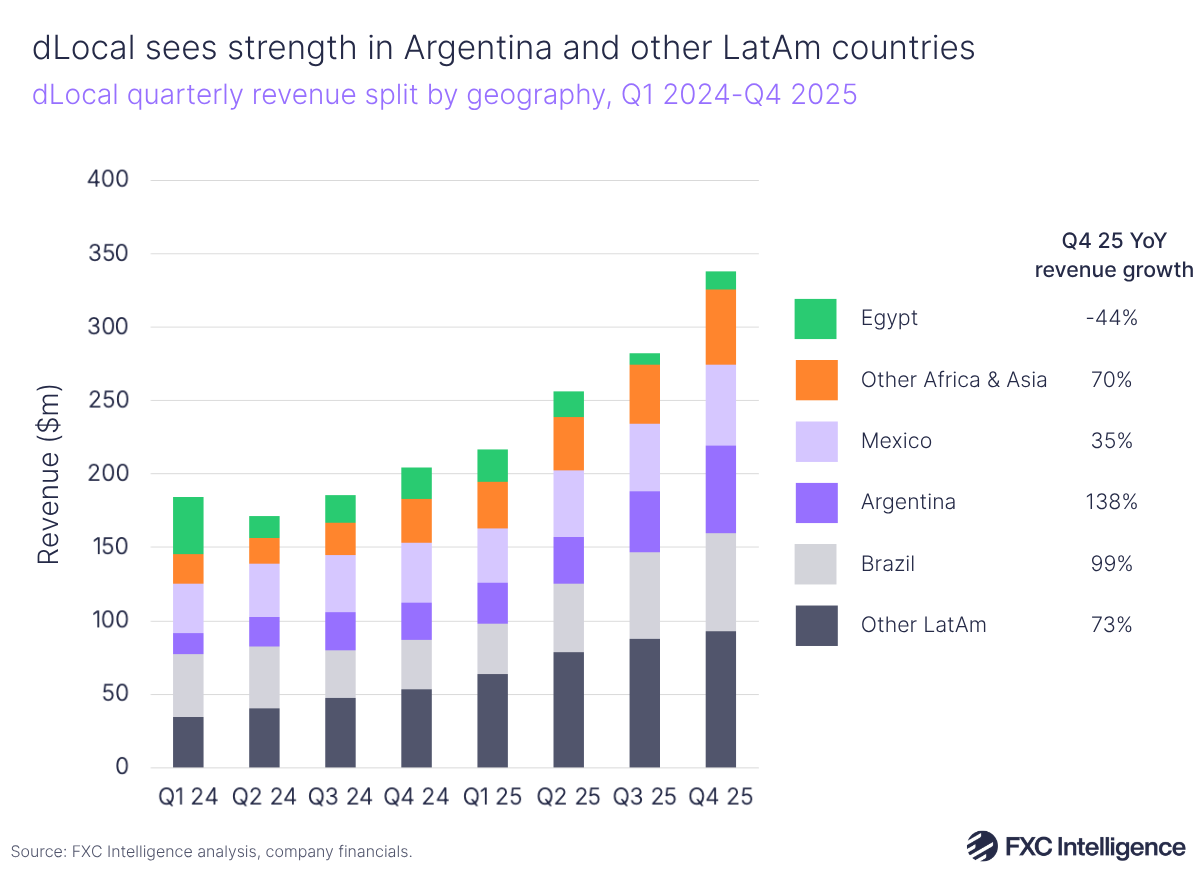
dLocal noted a particularly strong rebound in Brazil, which had suffered the previous year due to lower take rates related to another product launched by the company, but in Q4 25 saw strong seasonal ecommerce growth as well as “solid trends” across streaming, advertising, financial services and remittances. Brazil’s revenue grew 99% in Q4 2025 with gross profit growing by 133%. Mexico also saw strong growth in ecommerce and the company, driving 35% revenue growth and 15% profit growth YoY.
In some cases, dLocal noted some mixed metrics across markets. While Argentina saw solid volume growth and rising revenues, gross profit for this market declined by 9% YoY due to higher funding costs for installment payments amid rate volatility caused by the country’s election in October 2025. Egypt saw revenues and gross profit decline in Q4, but the company noted that partial recovery of volumes from a large merchant, as well as business diversification in the country, had boosted its gross profits QoQ.
Other LatAm and Other Africa and Asia markets grew revenue by 73% and 70% respectively, though gross profit grew faster for the Other Africa and Asia segment (69% YoY, versus 44% YoY for Other LatAm). The company noted broad-based growth in Other Africa and Asia, with South Africa growing considerably as dLocal adds more global merchants there.
During the earnings call, dLocal said it was increasingly focusing on the Middle East, Africa and Asia for expansion. Scaling with existing merchants into new countries will become a more important growth driver for the company in 2026, as well as diversifying its revenue across markets and merchants. The company added four new payments licences in Argentina, Chile, the UAE and the Philippines in 2025, bringing its total to 37 licences across 26 markets, and it also has 16 additional applications in process, including states in the US.
How remittances growth is benefitting dLocal
Daniel Webber:
Remittances remains one of your fastest growing segments. How are you approaching remittances, and how have you achieved this growth?
Guillermo Lopez Perez:
It’s a vertical in which we’ve seen a lot of opportunity and growth in the last few years. We are very happy with it. Obviously, we are providing value to our merchants, which is what we’re trying to do at the end of the day. It has also helped us with penetrating the wallet, from the merchant perspective, but it’s also helped us from an operational and netting perspective, so we have a healthy mix between pay-ins and pay-outs. I think it works for us really well.
Remittances grows share of dLocal’s volume mix
dLocal saw volume growth across almost all of its segments in Q4 2025. Remittances led growth in Q4 2025, rising by 139% and pushing it to become one of dLocal’s key volume segments alongside ecommerce, financial services and on-demand delivery. These segments grew by 85%, 35% and 135% respectively.
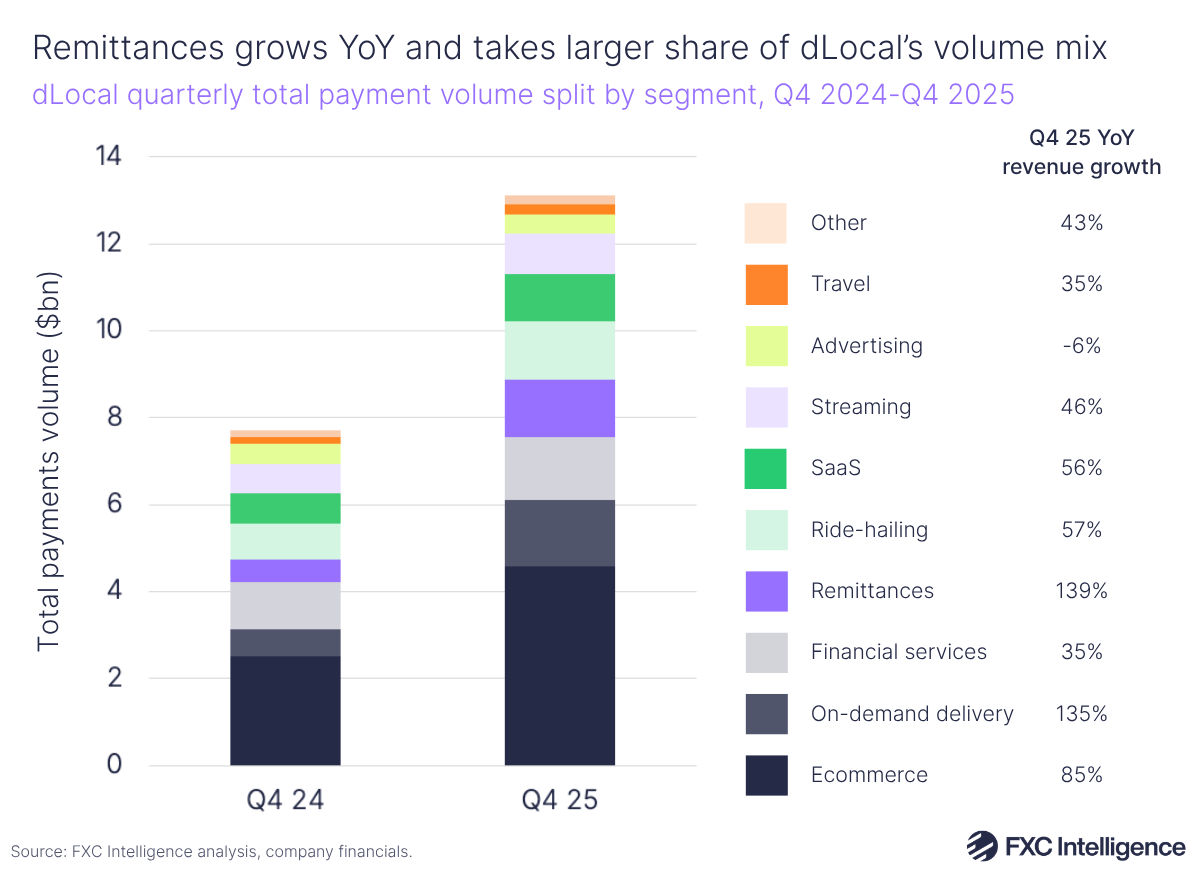
Pay-ins (where dLocal’s merchant customers receive payments) remain dLocal’s most significant volume driver, having grown 72% YoY to $9.2bn on the back of ecommerce, on-demand delivery, ride-hailing and advertising gains.
However, strength in remittances and financial services is also scaling volumes for pay-outs (disbursements in local currency to business partners or customers of dLocal’s merchants) with these growing 65% YoY to $3.9bn.
Where stablecoins will make the biggest impact for dLocal
Daniel Webber:
Talk us through where you’re seeing stablecoins have an impact, but also maybe some of the places where it isn’t having so much of an impact.
Guillermo Lopez Perez:
We see it as a natural extension of what we do, both across payment methods and treasury functions. We see more of an opportunity in the short term on the treasury and settlement side of things, and more of a medium-term opportunity from a payment checkout perspective as the consumers adopt it as a payment method.
Nowadays, it’s very small from a P&L point of view, it’s a nascent product at the end of the day. We have the full suite, so we do have full capabilities across treasury FX services, on-ramp and off-ramp. We’re working with key partners, such as Felix, BVNK, Circle and so on. So it’s ready to be used, but it’s not really a meaningful volume yet.
The merchants are starting to engage with it and understand it better to see if it’s a meaningful contributor to volume maybe in 2027 or 2028, but it’s not going to move the needle for us in 2026.
dLocal’s early steps into the card-present market
Daniel Webber:
You have some products in the pipeline for the card-present market, which is a big established space. How are you looking to position yourselves there?
Guillermo Lopez Perez:
Similar to the rest of our business, our go-to market approach is to build things for our merchants and go alongside them, so we don’t build things ahead of demand. As with stablecoins at this point in time, it’s a very embryonic product, so again, I wouldn’t overstate the impact in 2026. It’s still going to be small, as we’re just launching it.
But as you said, the opportunity is enormous. Currently, 100% of our merchants are digital merchants. There’s a case for a few of them or a few verticals to enter the card-present business.
It is a completely new space for us with other opportunities that we can jump into with some of our merchants, so it can really increase our TAM. Think about ride-hailing drivers that accept tips, for example. Or some of our digital merchants that have a physical presence as well.
The opex investment is very low in 2026, so it’s not going to have a meaningful impact either way. But at the end of the day, you go to the core proposition that dLocal offers and it’s the same thing. You have one integration that you can deploy across different markets and payment methods, and this is one of them.
Daniel Webber:
Anything else you would like to add or mention?
Guillermo Lopez Perez:
We’re very happy with 2025 and where we ended up, with very healthy growth and accelerating momentum, and we’re very hopeful about 2026 as well. We provided guidance and we hope that we can continue to deliver the growth, service and value that we provide to our merchants.