Wise has released its annual G20 Cross-Border Payments Scorecard for 2026, scoring G20 members and other selected nations on the ability to directly access payment systems and price transparency.
In total, 29 countries are assessed, plus the EU, with Wise’s report leveraging data from FXC Intelligence’s proprietary remittance dataset to identify the five largest non-G20 sending markets to the G20 – the UAE, Hong Kong, Spain, Kuwait and Malaysia – and the five largest receiving markets from the G20 – the Philippines, Nigeria, Guatemala, Pakistan and Bangladesh.
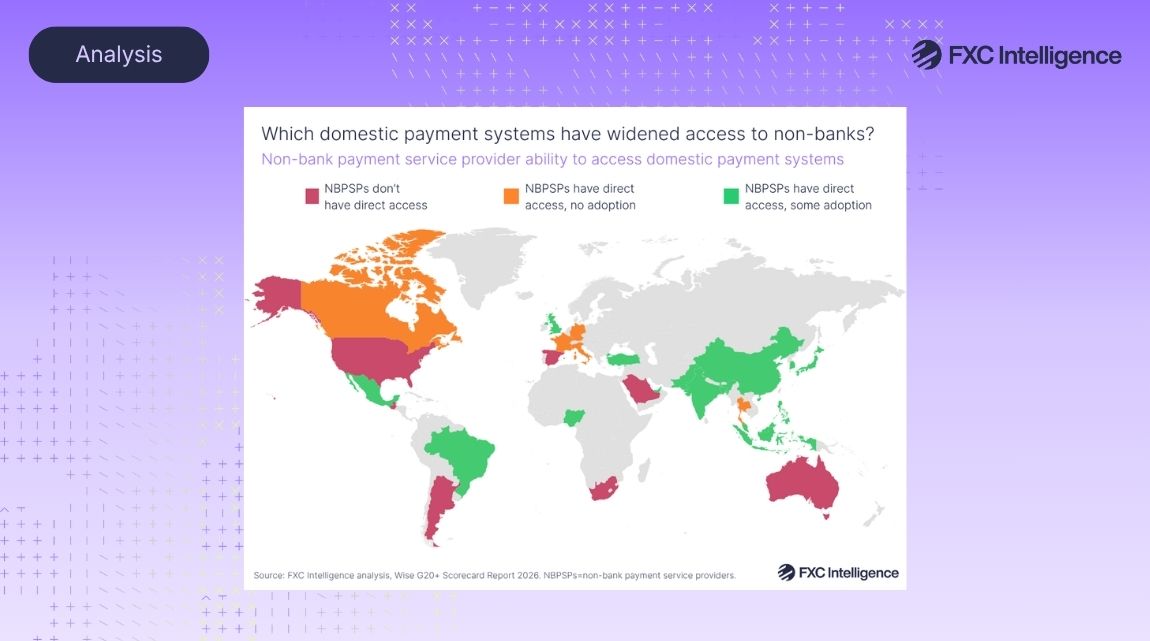
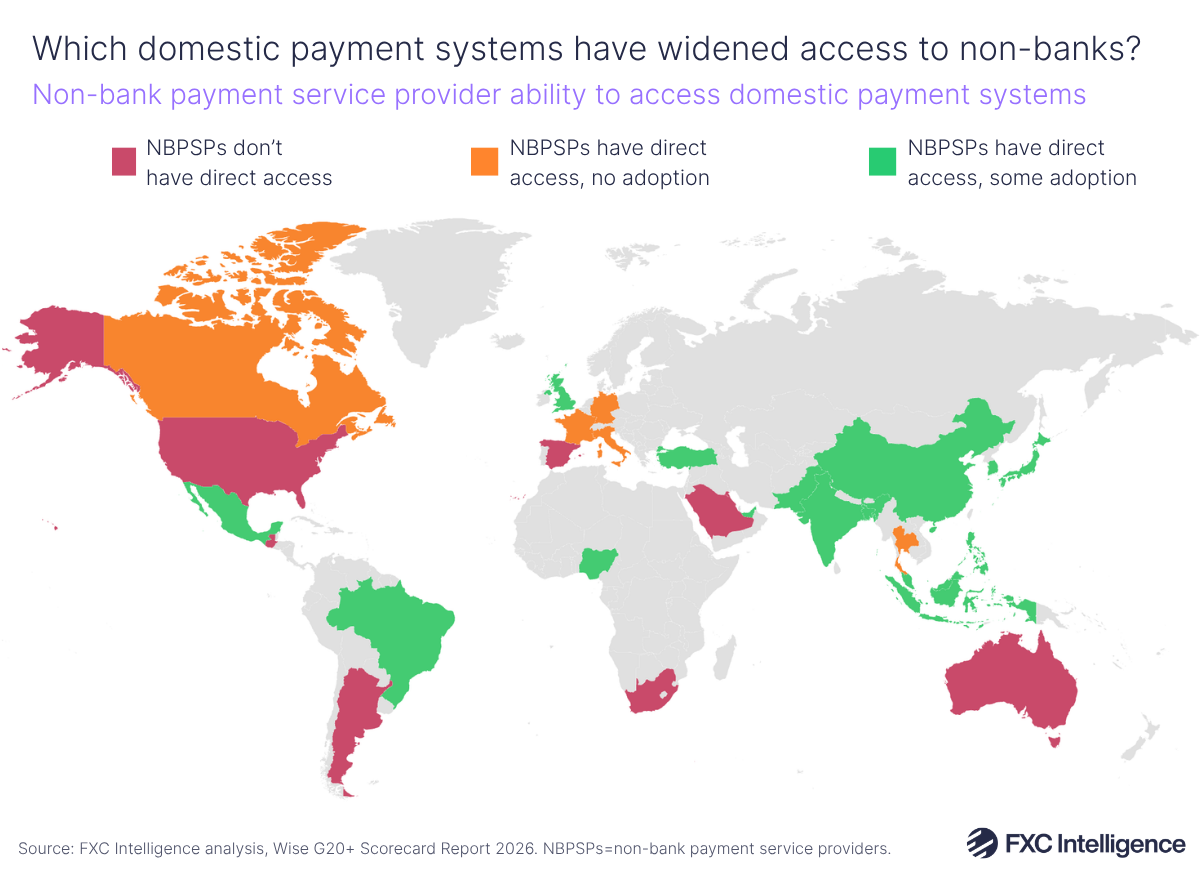
Of the individual countries covered in the report, 21 (72%) enable non-bank payment service providers (NBPSPs) like Wise to connect to their domestic payment systems directly, although five of these (24%) have not yet been adopted by a single NBPSP.
Meanwhile, only six (33%) of the G20 member nations covered in the report currently give NBPSPs full direct access to domestic payment systems and enable participants to settle via their respective central bank. The remaining G20 markets all require non-banks to depend on intermediary banks for at least one part of clearing or settlement.
Overall, Wise included eight markets that do not enable NBPSPs to access domestic payment systems in any form, although it says half of these are actively working to widen access to these participants.
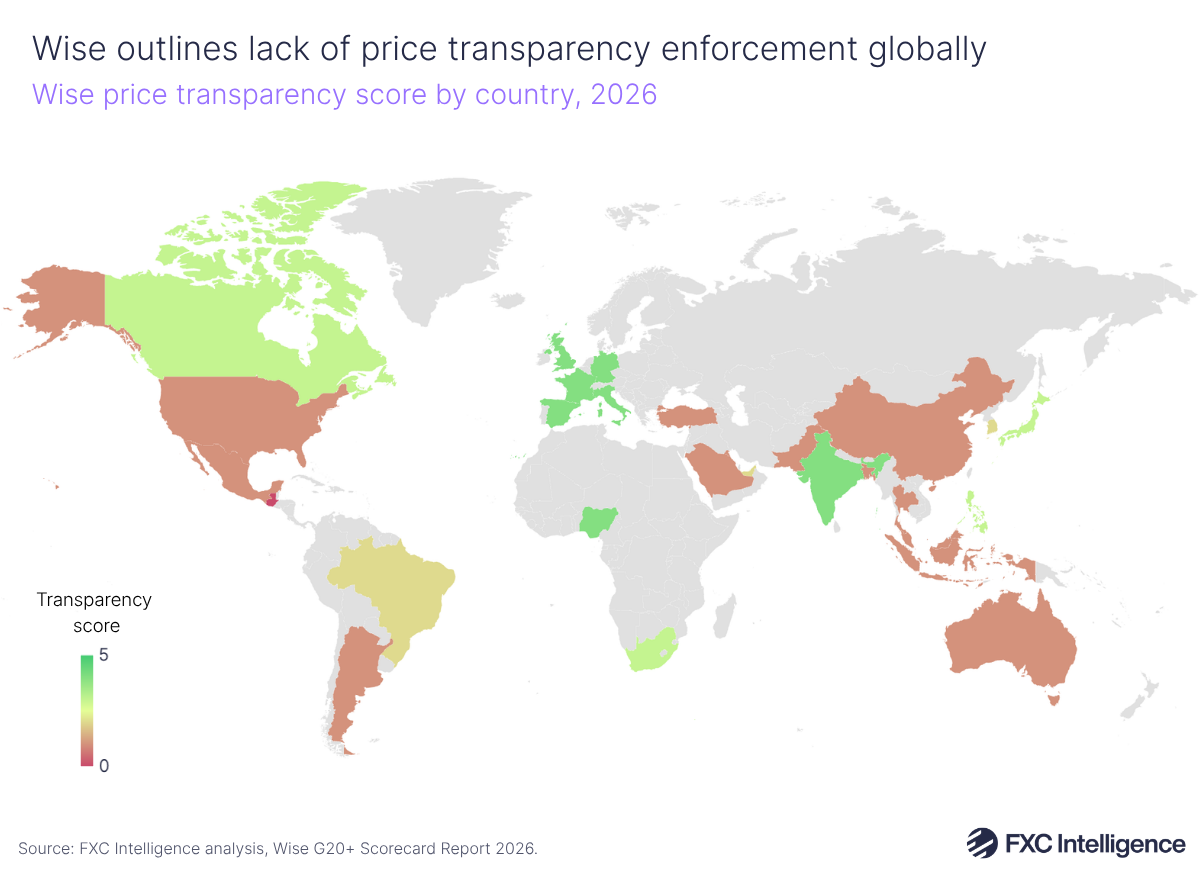
Wise also worked with our research team to examine what customers can see when sending money internationally across different providers, to help score countries based on price transparency.
Wise did not give a single assessed market a maximum score of five, with seven countries receiving a score of four. This included the UK’s score falling from five in Wise’s 2025 report to four this year, with the data showing that implementation of the UK’s Consumer Duty has not been evenly enforced across major providers.
“Despite clear FCA guidance in May 2025, major providers are still burying a 2-4% additional cost in bad exchange rates,” explains Magali Van Bulck, Head of Policy for EMEA at Wise. “Some have proven transparency is achievable, but most haven’t changed their behaviour at all. We’re shining a light on where the UK must improve at pace: respecting its own transparency guidance. While we wait, UK consumers are losing £9.8bn this year alone.”
These findings follow the Financial Stability Board’s (FSB’s) own annual update on its G20 targets for cross-border payments in October last year, in which it found that most end users were yet to be majorly impacted by the implementation of the FSB’s G20 roadmap actions and recommendations. In Wise’s 2026 report, the global money transfer company says that by giving NBPSPs full access to domestic payment schemes, these markets can reduce the average cost and time of payment processing. It is also urging markets to ensure providers disclose the full cost of cross-border payments and consistently enforce the rules to increase competition between providers and drive prices downward.