As the race for bank licences among digital payments players heats up, Revolut is pushing to grow its presence in Europe. Last month, the digital bank was granted a full banking licence in France, having recently gained licences in Australia, the UK and Mexico, and is now reportedly applying to add a new bank branch in Finland. We examine the state of licences for digital players on the continent, as well as what’s driving Revolut’s new dual-hub strategy in Europe.
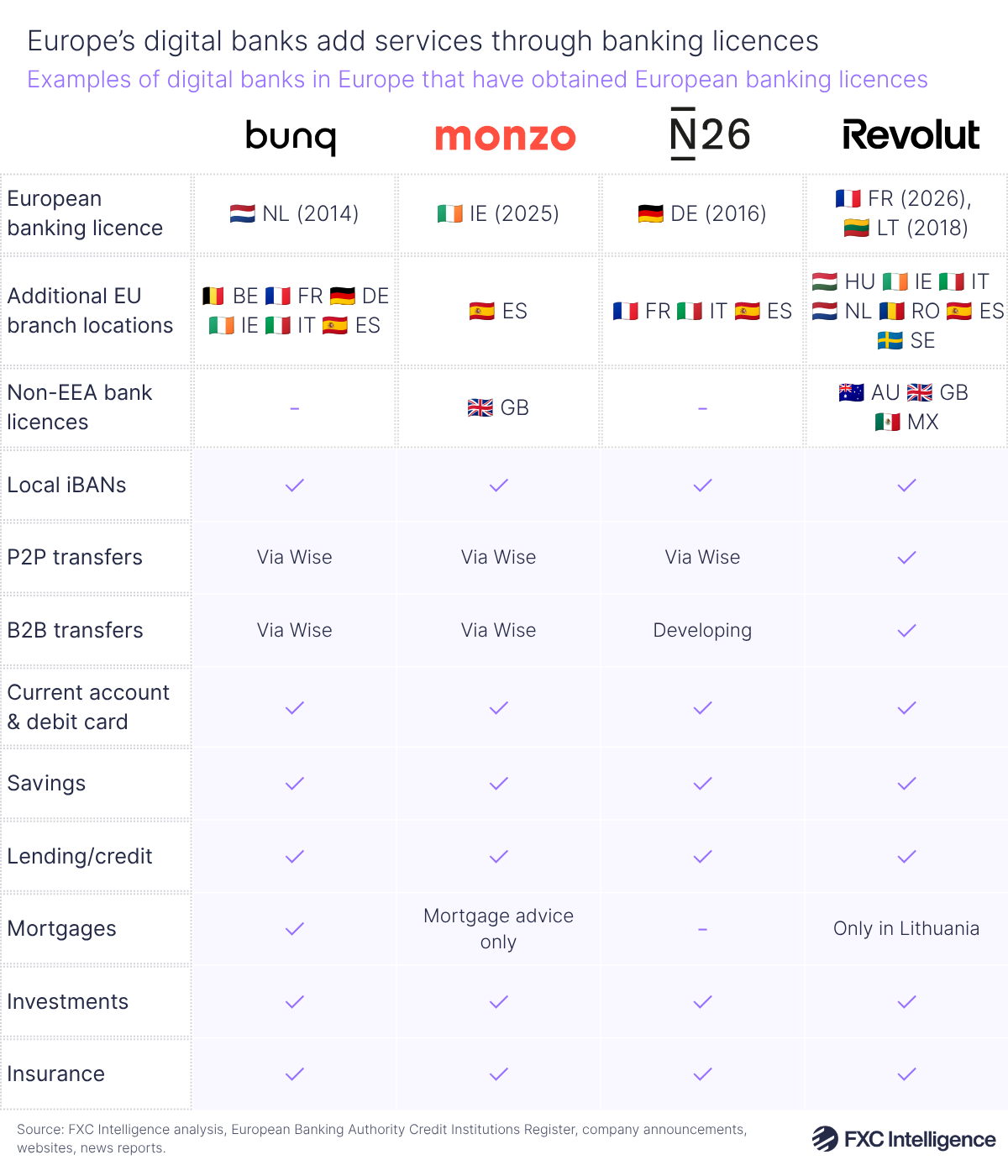
Revolut is one of several digital neobanks offering money transfers that have sought to add bank licences as they expand their customer reach and products to customers, with other major examples in Europe including bunq, Monzo and N26. Having added a Dutch banking licence back in 2014, bunq filed applications for licences in the US and Mexico in 2026, with the former being rejected. N26 added a German bank licence in 2016, and has since expanded to France, Italy and Spain, while Monzo added a licence in Ireland back in December 2025 and has now launched its services to Spain.
Adding these licences has allowed digital providers to layer on additional banking services, spanning current and savings accounts, debit cards, lending and credit services, investments and even mortgages. One aspect that has been particularly important has been the addition of local IBANs in Europe, which give users country-specific bank account numbers matching domestic banking regulations. This allows users to avoid IBAN discrimination, whereby payments are refused or delayed as they don’t have a local country code.
Gaining at least one licence in the EU market is significant for these companies’ expansion, as EU passport rules mean a neobank can expand and add branches in other member states across European Economic Area (EEA) countries without getting a separate local licence in each new location. Where Revolut stands apart is its decision to apply for a full EU bank licence in France, despite the fact that its Lithuanian entity, Revolut Bank UAB, already has access to the EU bank market through a licence obtained in Lithuania in 2018.
Through the French licence addition, Revolut has effectively created a dual-hub structure, with its French entity, Revolut Bank S.A., set to serve customers across Europe as well as targeting specific markets in Western Europe, including Germany, Ireland, Italy, Portugal and Spain, while its Lithuanian entity acts as a “cornerstone” for operations in other EEA countries. European customer accounts will now be protected by France’s national deposit guarantee, though this is the same amount (€100,000) as Lithuania’s scheme.
So why the need for a new banking licence? Revolut had initially targeted Lithuania as a route to getting a European bank licence for the “speed” of decision-making by its Central Bank, Revolut CEO Nik Storonsky told the FT in a 2022 interview. However, adding this new licence allows it to reduce risk and build more trust with customers in a market that is closer to its largest and fastest-growing customer base.
Western Europe accounts for more than 30 million of Revolut’s customers (out of 80 million customers globally) and on its website, Revolut says that the additional EU licence in France is “prudent business practice” as it continues to grow, allowing it to deepen its presence in Western Europe and “provide tailored services more effectively to millions of customers in the region”. The company has also recently committed to hire more than 600 people and invest over €1bn in the region, as well as open a new HQ in Paris, France.
Revolut’s initial licence has allowed it to boost its reach before adding in an additional licence that better reflects its growth plans. A key aspect here is trust, and alongside the potential to offer more products, the more digital banks acquire licences, the more this puts them on equal footing with existing incumbent banks, opening up more opportunity to capture customers in local markets.