Following the launch of our joint report at Money20/20 Asia, we’ve continued our partnership series with the leading fintech show with the launch of our next white paper in the series: Europe’s Cross-Border Payments Crossroads.
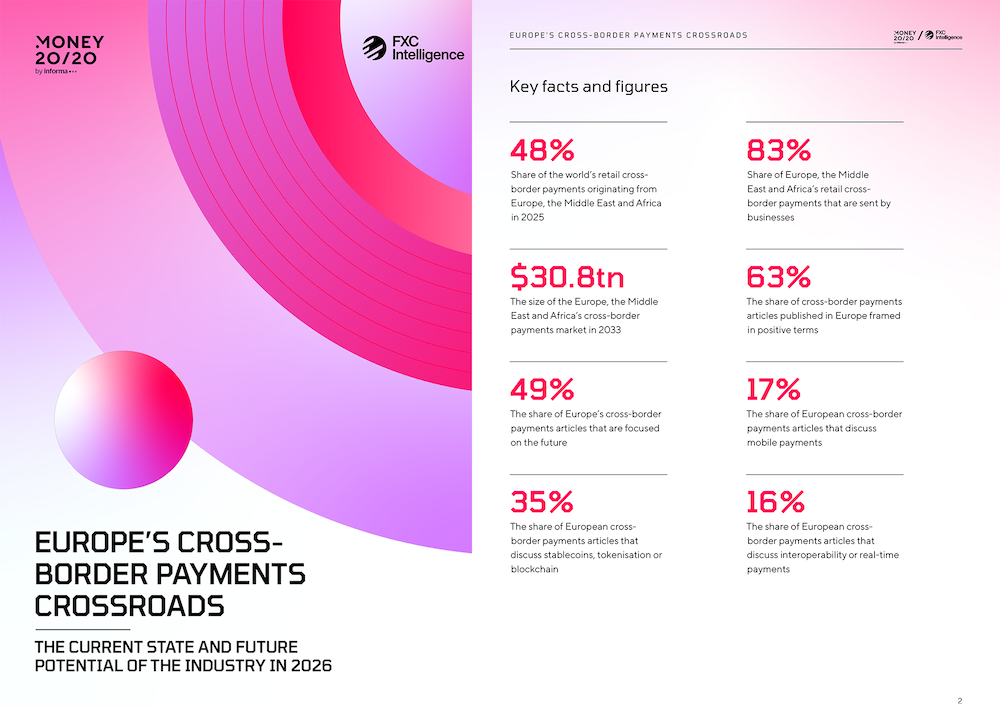
Following a similar research format to the Asia version, as well as harnessing our own market sizing data, the paper saw us conduct granular analysis of over 1,000 industry articles published across 14 different key European markets, aided by both AI and our own research and payments expertise. This enabled us to pinpoint where the industry is heading and identify the topics of biggest focus and concern, showing that Europe is at a critical juncture in deciding how it steers the future direction of its cross-border payments infrastructure.
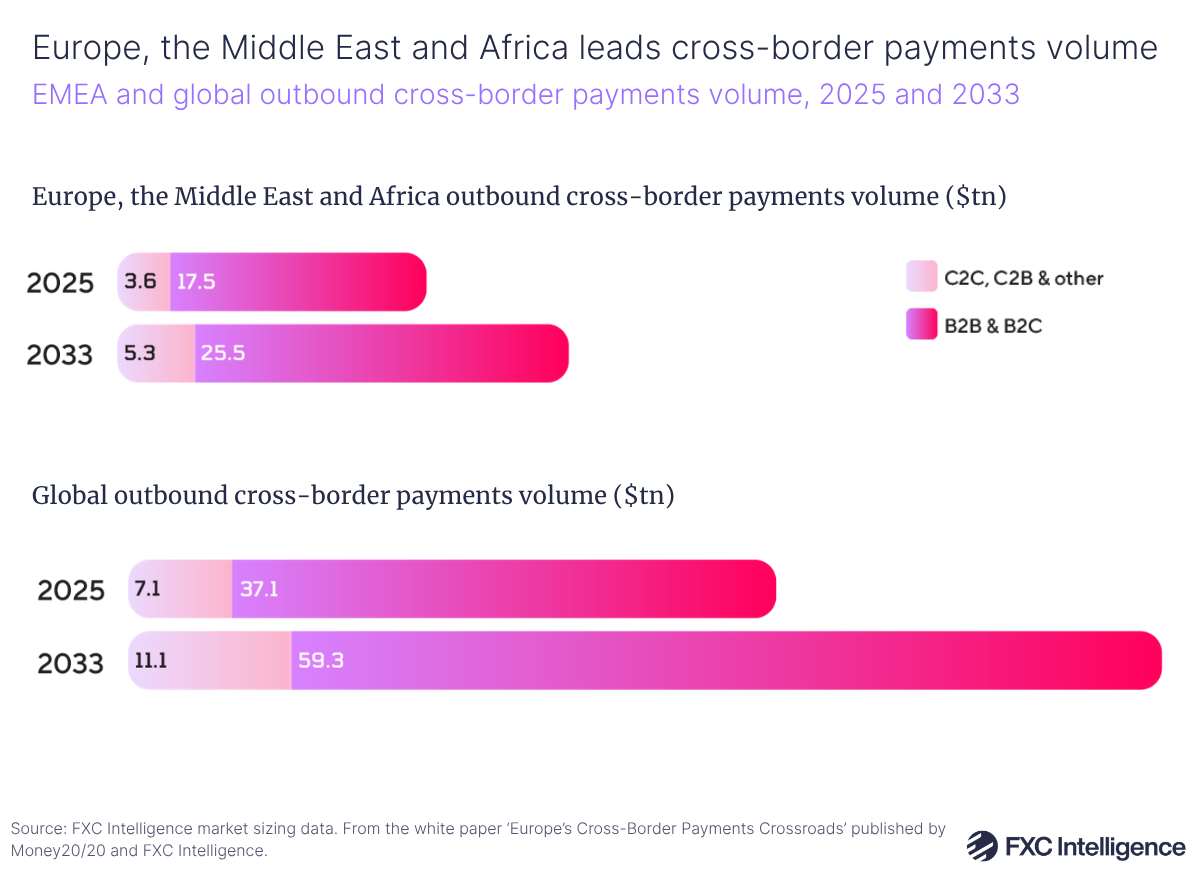
Our market sizing data shows that in 2025, Europe, the Middle East and Africa (EMEA) saw outbound non-wholesale cross-border payments reach $21.1tn, or 48% of global outflows, making it the largest regional bloc globally. While it won’t grow as fast as some other regions, it is still set to keep this title in 2033, when volumes from the region are expected to climb to $30.8tn. While the Middle East is set to see outsized C2C remittance growth, Europe will be key to driving the growth of cross-border service payments in particular.
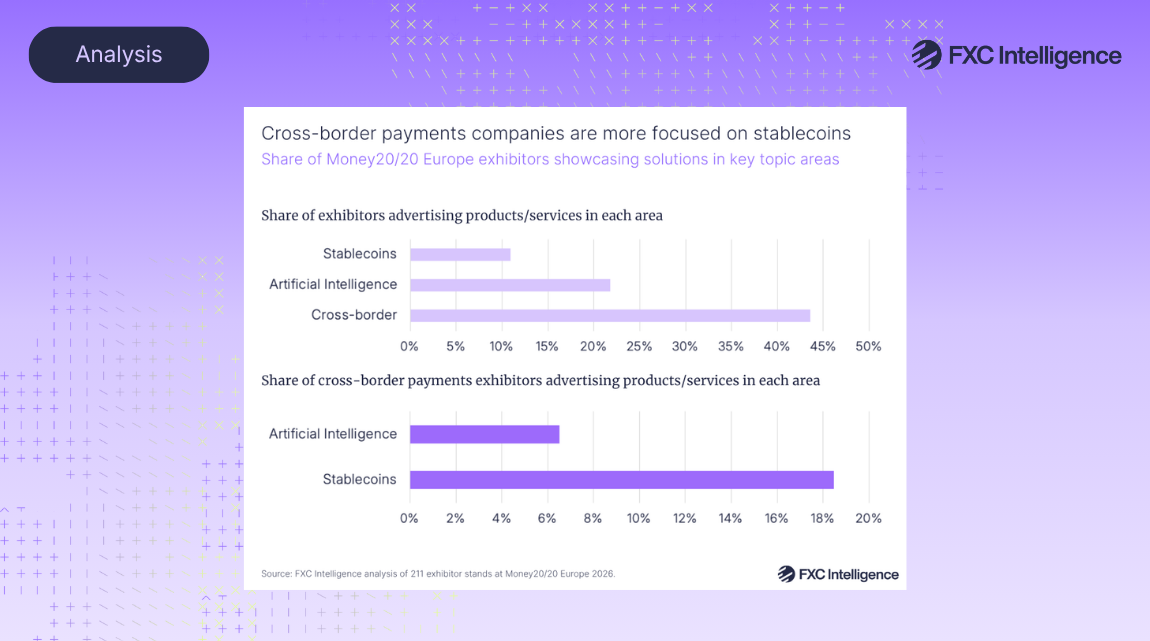
Improving money movement from the region requires Europe to continue to make gains in its infrastructure development, with interoperability, real-time payments and digitalisation all being key areas of focus for the region. However, stablecoins saw by far the most coverage, and a greater share than we saw in Asia, reflecting how much of the industry is keen to see where the technology can play a role.
However, there was also a notable tonal shift from previous years, with a much greater presence of geopolitical and payments sovereignty-related discussion and concerns running through the coverage. Most of the discussion of other countries focused on key markets beyond Europe, with the US firmly in the lead, and questions around dedollarisation and payments infrastructure sovereignty were commonplace.
Europe is grappling with questions over how much of its money movement is on European-owned rails or in European currencies, and these questions are likely to have a lasting impact on how the region shapes its future infrastructure.
The full white paper, which includes both country and trend-level analysis, as well as a review of the most-discussed companies in the region, can be downloaded via Money20/20’s website.