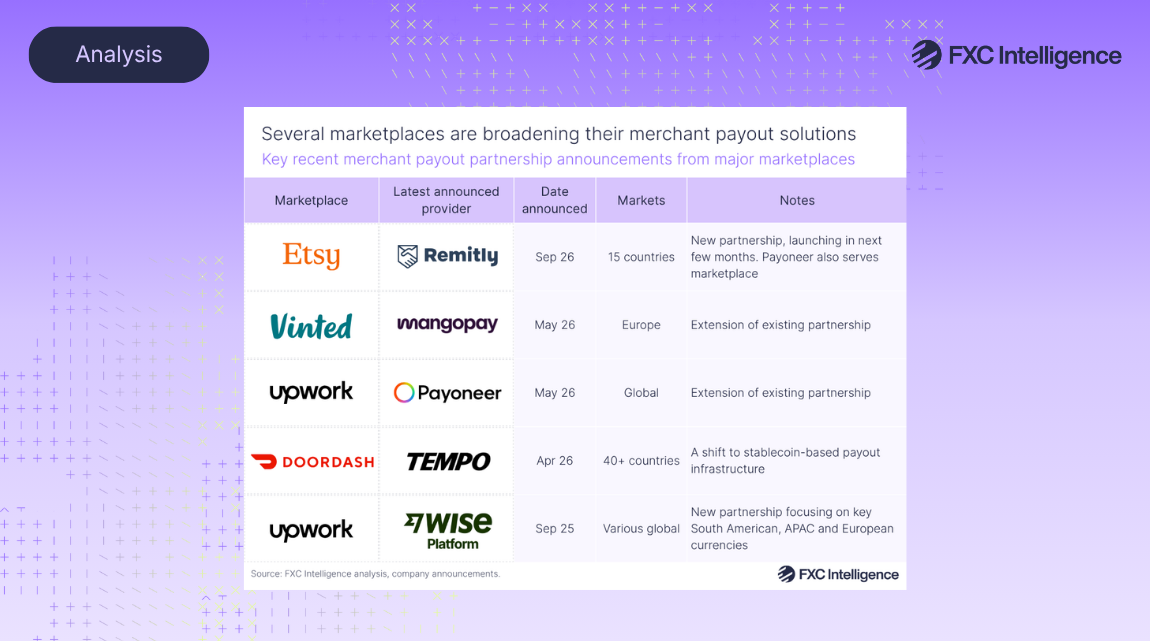
Last week, Remitly became the latest cross-border payments company to enter the merchant payouts arena, joining Payoneer in a partnership with creative marketplace Etsy. As the latest in a number of key partnerships, is it a sign of changes in the sector?
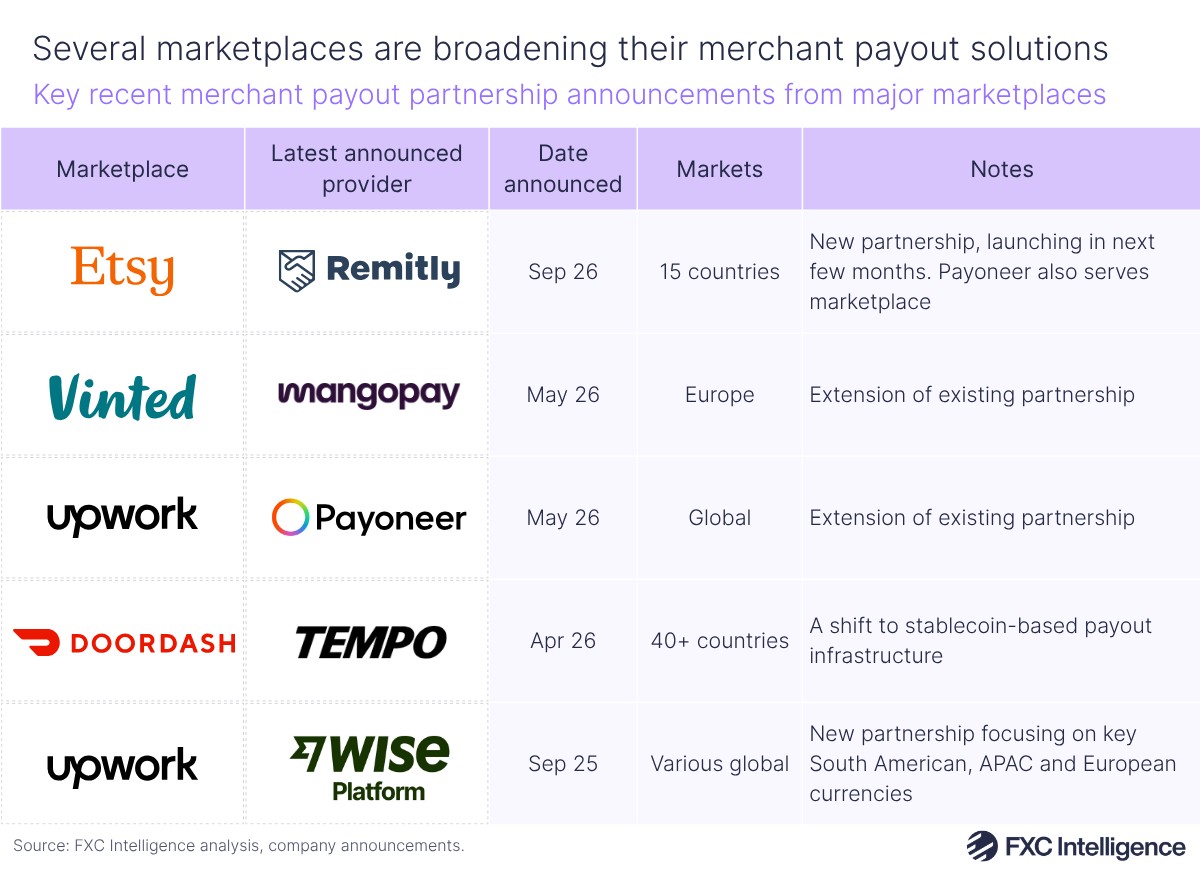
Set to go live in 15 markets in the next few months, Remitly’s Etsy partnership is the first time that the company has moved in the marketplace merchant payouts space. While it has traditionally been a digital remittances provider, the company has increasingly been making moves beyond its core sending group and, as CEO Sebastian Gunningham recently told us, is now also targeting high-value senders, businesses and receivers. This development broadens its addressable market further still, and sees the company join Payoneer as a provider for Etsy sellers.
Payoneer is a more traditional provider of marketplace payout solutions, having served the space for many years. Its recent extension of its partnership with Upwork comes alongside its work with a host of other leading marketplace platforms, including eBay, Fiverr, Alibaba and Amazon. However, news that it is set to be acquired by Nuvei may ultimately broaden the company’s offering, with Nuvei CEO Phil Fayer highlighting how the acquisition is set to broaden Nuvei’s capabilities and ultimately enable it to serve a wider pool of companies’ payments needs.
Mangopay is a smaller but similarly marketplace and platform-focused company, having cemented its position in the space with the extension of its partnership with fashion marketplace Vinted, alongside other brands including Gumtree. With strong wallet and multicurrency account capabilities, the company is also increasingly serving companies in the digital assets space, including Bitpanda and Ramp.
Digital assets are also finding their way into conventional marketplace payouts, with Stripe’s blockchain brand Tempo announcing a partnership with DoorDash earlier this year that sees the company integrate stablecoin-based payout infrastructure for its workforce. This replaces the previous fiat rails but maintains the same payout experience for recipients, improving speed and costs while still paying out in fiat.
Meanwhile, while Wise Platform has seen many of its recent partnerships focus on fintechs and banks, the company has also made moves in the marketplace space, including a partnership with Upwork. Although a small part of Wise’s business, accounting for 6% of the company’s revenues, Wise Platform is seeing rapid growth as the company looks to further leverage its proprietary infrastructure.
Marketplaces are a key business area for many types of payments companies looking to further utilise their underlying networks, with fast-evolving requirements and broad geographic reach that often align closely with the needs of cross-border consumer payout solutions. It is therefore no surprise that more types of cross-border payments companies are looking to cater to the space. Expect to see this space evolve further in the future, particularly as consumer-facing companies look to diversify their revenue stream further.