This week sees the launch of Mastercard’s white paper ‘Principality at Risk: How Friction and Uncertainty Erode SME Cross-Border Relationships’, developed in partnership with FXC Intelligence, which brings to light the extent of the SME cross-border payments opportunity in Latin America.
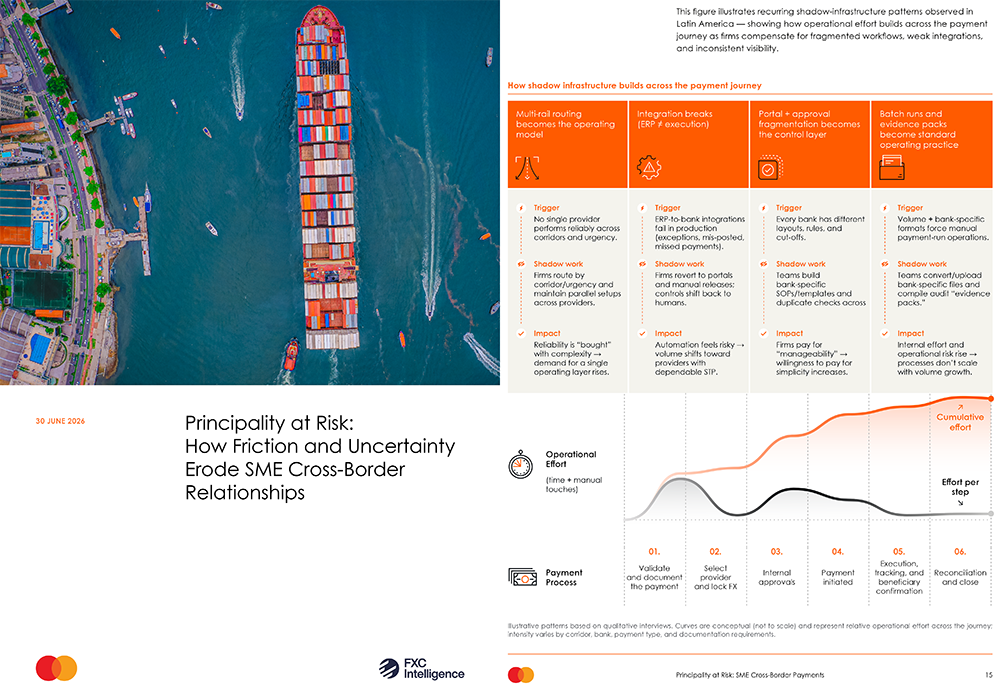
The white paper, which is underpinned by our extensive qualitative research focused around in-depth interviews with businesses in Latin America, shows that SME cross-border payments represent a significant opportunity in the region, at around $23bn in annual revenue, with the figure continuing to grow.
Crucially, who handles the flow that generates this revenue is changeable. 9 out of 10 businesses are open to switching cross-border payments providers, putting around 70% of cross-border payment volume at potential risk of migration.
This is in contrast to core banking services such as credit, payroll and collections, with cross-border payments being re-routed on a corridor-by-corridor basis. As a result, banks risk losing wallet share despite retaining clients in name.
The study also identifies significant levels of operational friction, as well as a high need for exception handling, with around one in nine payments requiring additional action – a process that can take up to 3.5 hours of staff time. The lack of clarity on when payments arrive and what deductions will apply is also a concern for many SMEs in the region.
The white paper, which you can access in full via Mastercard’s website, also details how SMEs are:
- Utilising multiple providers to route payments
- Using reliability and predictability as key determinants of flow allocation
- Trying different options on a corridor-by-corridor basis.