Last week, Citi held its first company-wide investor day since 2022, during which it outlined the significant progress it has made since then and broke down how it plans to further bolster growth and set out new growth targets.
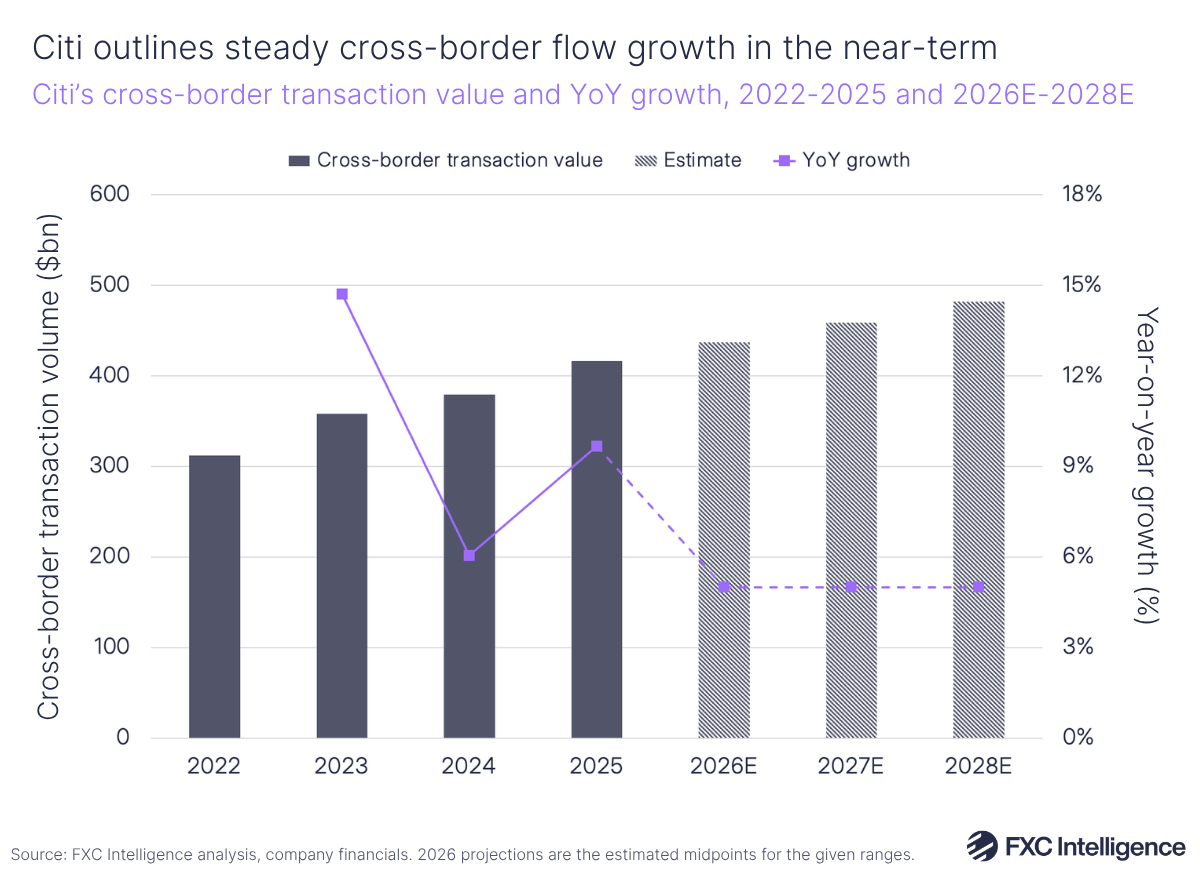
As part of Citi’s outlook for the near-term (2027-2028), the bank is targeting a modest mid-single-digit compound annual growth rate (CAGR) for its cross-border transaction value, defined as the total value of cross-border FX Payments processed through the company’s Worldlink and Cross Border Funds Transfer platforms. This growth would see its cross-border value increase from $416bn in 2025 to $482bn in 2028.
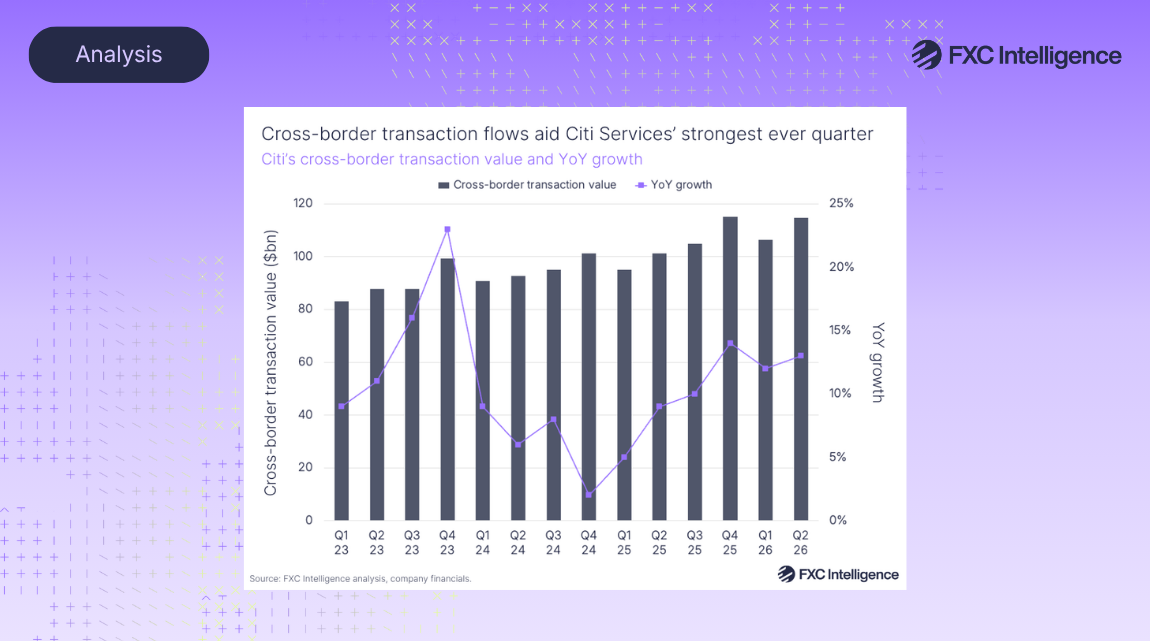
This projection comes shortly after Citi released its Q1 2026 earnings, in which it saw cross-border transaction volume increase 12% YoY to $106.3bn – putting the bank on track to outperform this near-term target in 2026 assuming consistent growth across the year.
Citi is also targeting low to mid-single-digit revenue CAGR and mid-20s return on average tangible common equity for its overall Services division, which contains the bank’s Payments segment. During the investor day, CEO Jane Fraser outlined that Services is already currently delivering within this range and that the bank is confident it can maintain this.
Citi outlines digital asset strategy progress
Citi’s Head of Services, Shahmir Khaliq, also outlined the bank’s digital asset strategy, which includes plans to further expand its in-house digital asset platform, Citi Token Services (CTS).
CTS is currently live in five markets and supports US dollar and euro flows, with “hundreds of clients” now moving close to $1bn per day. As part of efforts to solve interoperability challenges between digital assets and fiat, it plans to embed this platform into its 24/7 US dollar clearing solution, linking into Citi’s plan to act as a bridge between fiat and stablecoins.
Khaliq also revealed that Citi is set to launch custody services for native crypto assets including bitcoin in the near future and is now setting its sights on servicing some of the largest Virtual Asset Service Provider companies.
“This is a high-growth segment where we are supporting treasury, management and payments while also helping them build on and off-ramps for their respective services with both traditional and digital asset solutions,” he explained.
On the topic of stablecoins, Khaliq also reiterated that Citi remains “open-minded” and that the bank is continuing to evaluate the possibility of issuing its own Citi-branded stablecoin over time and as its clients’ needs evolve.
AI is already boosting Citi’s businesses
AI also became an important topic during the latest investor day, with Fraser explaining that Citi’s implementation of the technology is “enterprise-wide” – accelerating product development, improving efficiencies, strengthening cybersecurity and supporting its workforce with AI tools.
Fraser explained that the bank is leveraging AI to support “a multitude of major revenue generating use cases” within its Services division, while Khaliq outlined the two primary goals for Citi’s AI strategy: enhancing its clients’ business models and improving its own international processes and operational efficiency.
The technology currently helps to boost the business’ development times by 30-40%, leading to Citi Services now deploying generative AI to support around 6,000 service agents across 72 countries worldwide – ensuring they can more quickly support the over three million inquiries they receive annually.
Looking to the future, Citi hopes its significant investment in emerging technologies can enable it to leverage its global network to grow its revenues.