Standard Chartered reported 3% growth in its quarterly operating income to $5.7bn in its Q2 2026 earnings. It also saw growth in its cross-border-led Corporate & Investment Banking (CIB) arm.
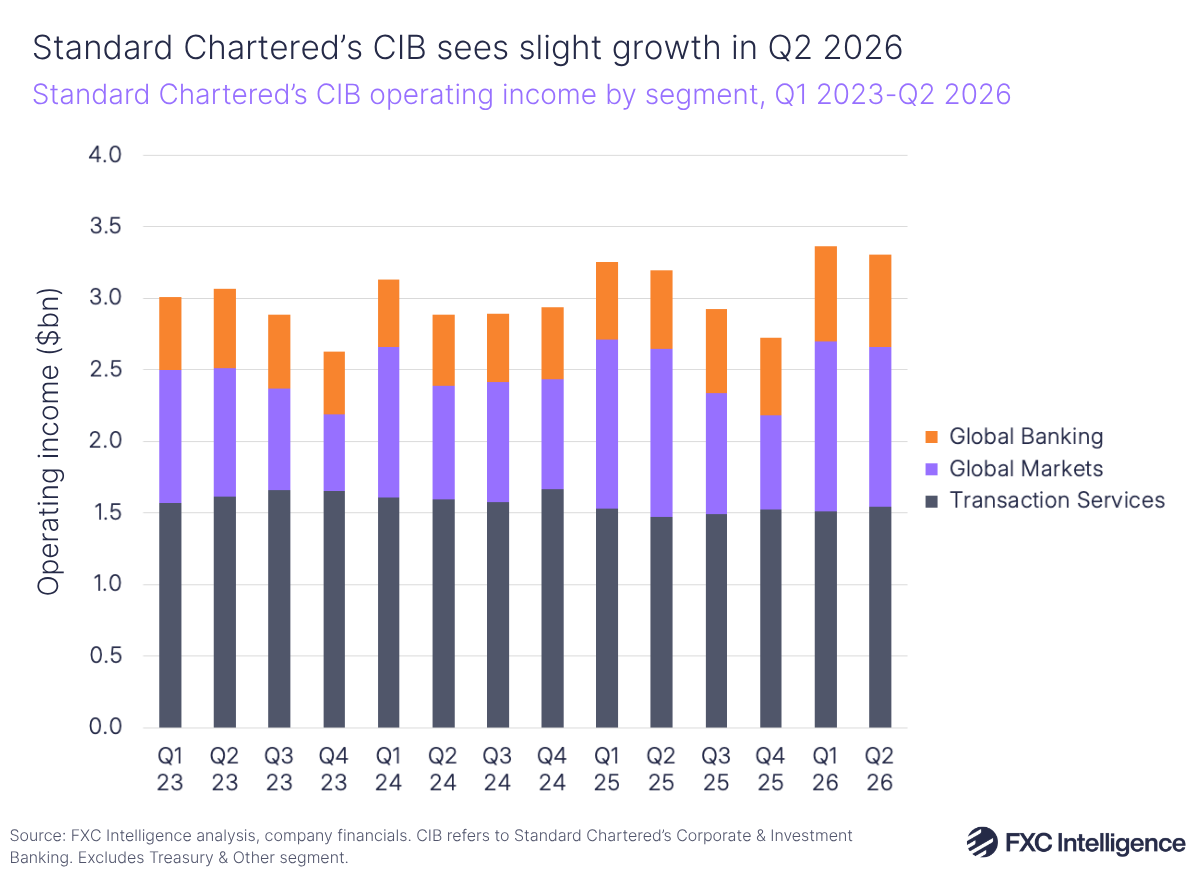
The bank’s CIB division, which contains the majority of its cross-border revenue and typically makes up around 60% of Standard Chartered’s operating income, saw its own operating income increase 2% YoY to $3.3bn in Q2 2026.
Within this, CIB’s Global Banking segment saw the strongest growth, rising 19% YoY to $0.7bn operating income. Transaction Services, which accounts for the majority of Standard Chartered’s cross-border income, grew by 5% to $1.5bn. This growth was largely driven by higher volumes and fees, with the bank sharing that it saw growth spread across payments and liquidity, security services and trade.
Although CIB’s overall Global Markets segment declined 5% YoY, flow income – the flow income generated by the bank’s Global Markets business (such as foreign exchange) – grew by 16% YoY. During the earnings call, Group CFO Manus Costello explained that continued investments into technology and digital platforms helped drive improved FX performance. Bill Winters, Group Chief Executive at Standard Chartered, also described flow income as “the gift that keeps on giving” as the bank continues to invest in this area.
Winters also discussed how the bank plans to approach digital assets, focusing on three key areas. Standard Chartered plans to help clients connect to new rails for issuance and settlement; provide banking, payments, liquidity and risk management services to digital asset firms; and enable clients to securely transact using digital assets. Ultimately, the global bank plans to continue to invest in this area to support its future cross-border payment services, acting as a “super connector” that moves money and assets globally for its clients.
Following the positive quarter, Standard Chartered increased its guidance for the full year to be around the middle of its 5-7% range.