The FXC Buyer’s Guide: Stablecoin Payment Infrastructure has now been launched (learn more about purchasing a subscription or read the executive summary). To mark its release, we continue our series of explainers on the technical aspects of stablecoin infrastructure this week with a look at payments settlement and finality, and what it means when blockchain-based payments are involved.
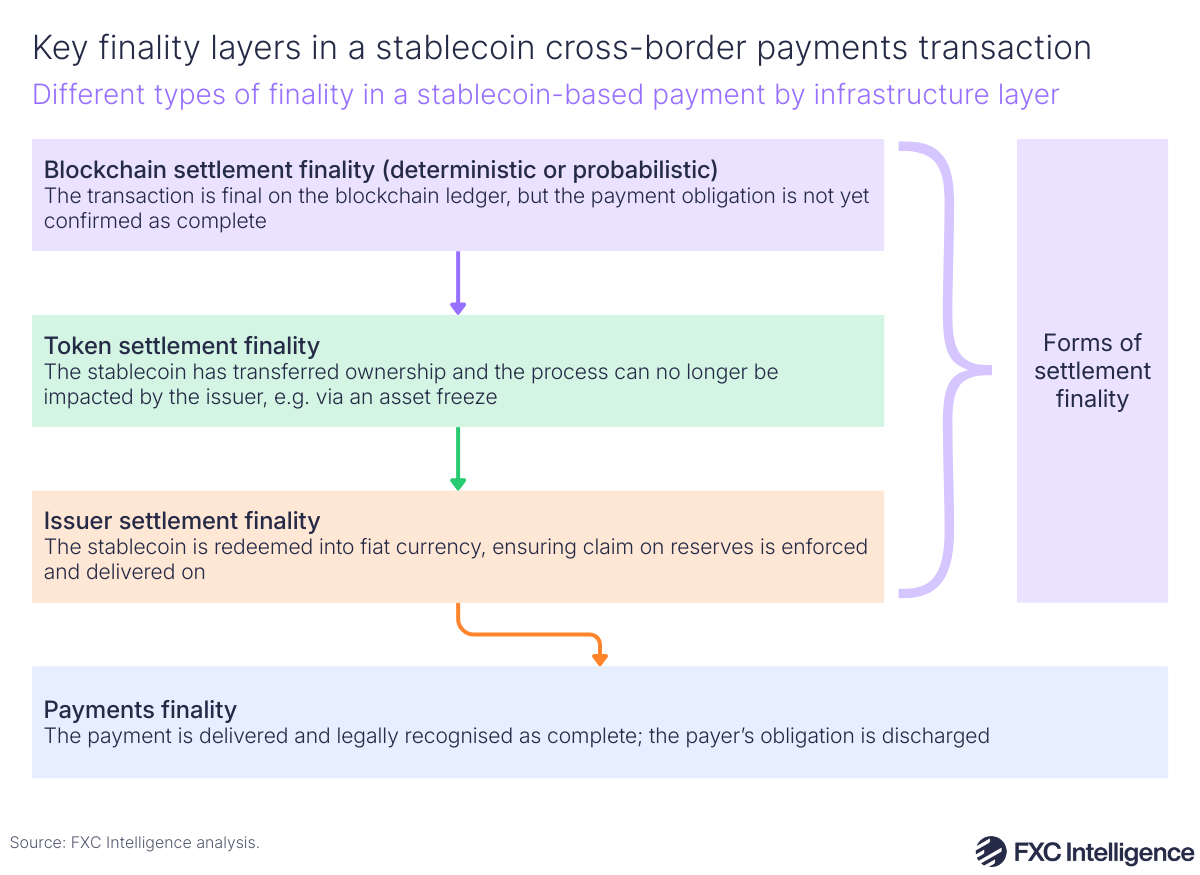
In basic terms, settlement refers to the point at which a blockchain-based cross-border payment is completed, however the reality is slightly more complex. With multiple intermediaries, different legal jurisdictions, intersecting technologies and potential challenges around liquidity and counterparty behaviour, reaching the point where a payment is truly settled and legally complete requires multiple steps.
This end point, where a payment is completely delivered, the obligation related to it is discharged and the recipient can treat it as received without worrying about a risk of chargebacks or similar, is known as payments finality. However, before this happens the payment initially reaches the similar but crucially distinct point of settlement finality, where the transfer of value is irrevocable and the transaction cannot be unwound, but the legal obligations have not yet been resolved.
The technical process of settlement finality is itself made up of several elements, each of which concern a different part of the infrastructure stack. The initial part is blockchain finality, where the transaction has been completed on the blockchain in question’s ledger. However, the step beyond this is token settlement finality: the point at which rules around the stablecoin’s management and ownership, including issuer controls such as freezing in response to sanctions, have been resolved and the settlement is economically final from the issuer’s perspective.
Beyond this is issuer settlement finality: the point at which the funds are converted into fiat and any questions around liquidity or an issuer’s ability to redeem to the stablecoin are resolved. Once this has happened, the payment can be delivered to the end user and the end point of payments finality can be achieved.
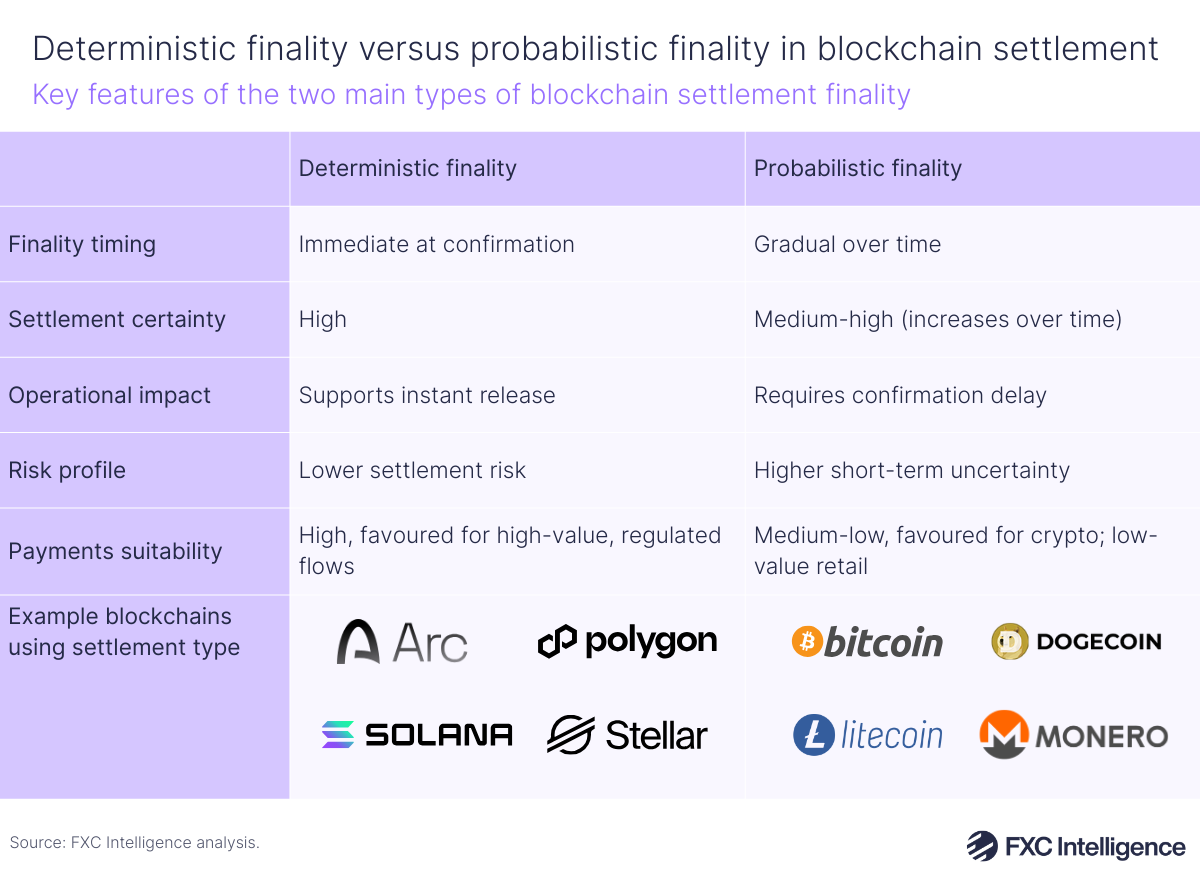
While there are multiple layers of finality, not all blockchains take the same approach, and there are two different dominant models for blockchain-based settlement that can have an impact on how quickly ultimate payments finality is achieved: deterministic finality and probabilistic finality.
Deterministic finality sees a transaction become final at a specific point in time, at which point it cannot be reversed. This makes it popular for payment providers, with the approach being used for the vast majority of blockchains favoured for stablecoin transactions, as well as several emerging payments-focused blockchains, including Circle’s upcoming Arc blockchain.
Probabilistic finality, meanwhile, sees the chances of a transaction being reversed become less and less likely over time, with providers typically having their own set point where they treat the transaction as concluded, based on their own defined level of acceptable risk. Popular with crypto-focused blockchains, this approach is less suitable for payments where predictability is key.
FXC Buyer’s Guide: Stablecoin Payment Infrastructure is now available to license via subscription. Learn more about the product and express interest in subscribing.