Visa and Mastercard have shared their calendar Q4 2025 results (which Visa reports as Q1 2026), with cross-border volumes driving continued growth for both. We take a look at each of the major payment networks’ financials, with a key focus on their cross-border performance.
In their latest earnings results (spanning October to December 2025), both Visa and Mastercard reported growth in cross-border volume – a key driver behind revenue growth for each company.
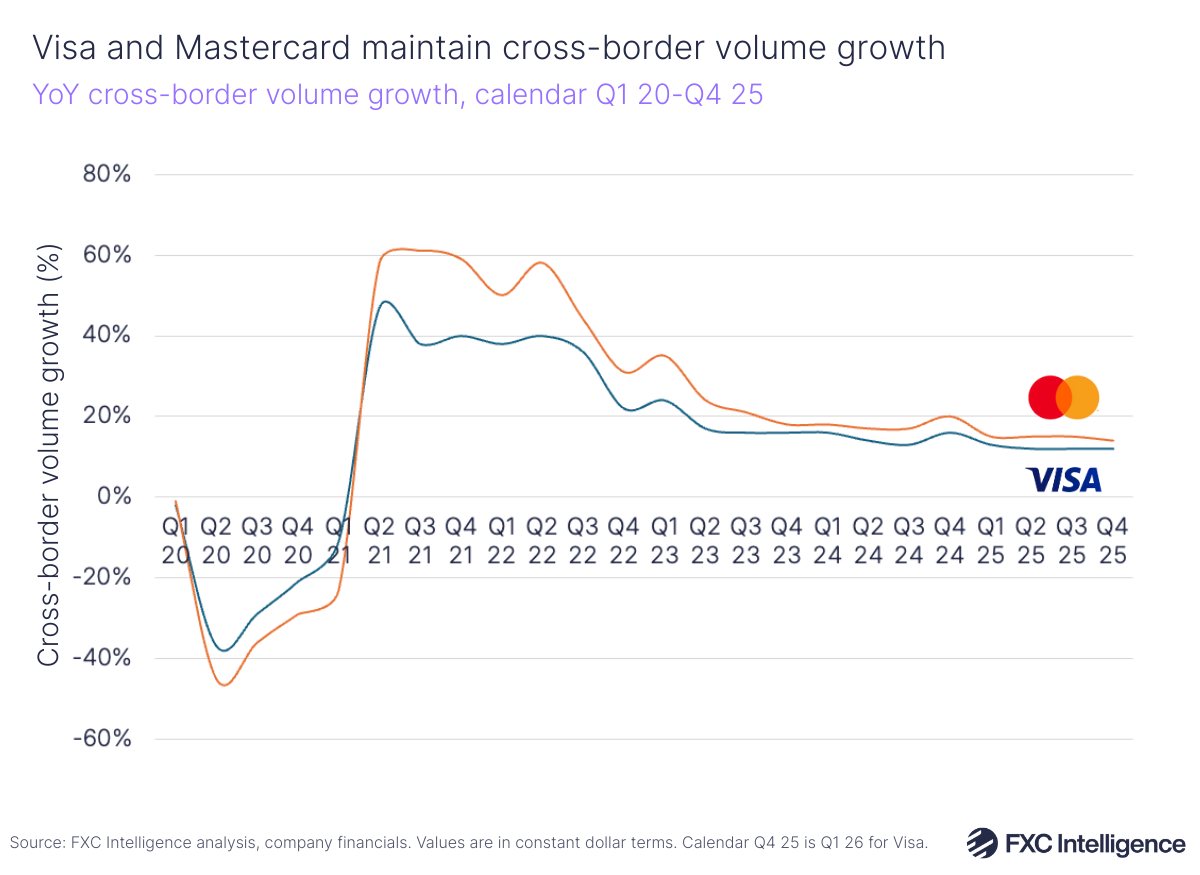
While neither Visa or Mastercard report exact cross-border volumes, both share details about YoY cross-border volume growth. Here, we take a look at some of the key drivers behind recent growth, alongside current focuses for each company, including stablecoins and agentic commerce.
Visa Q4 2025 earnings results
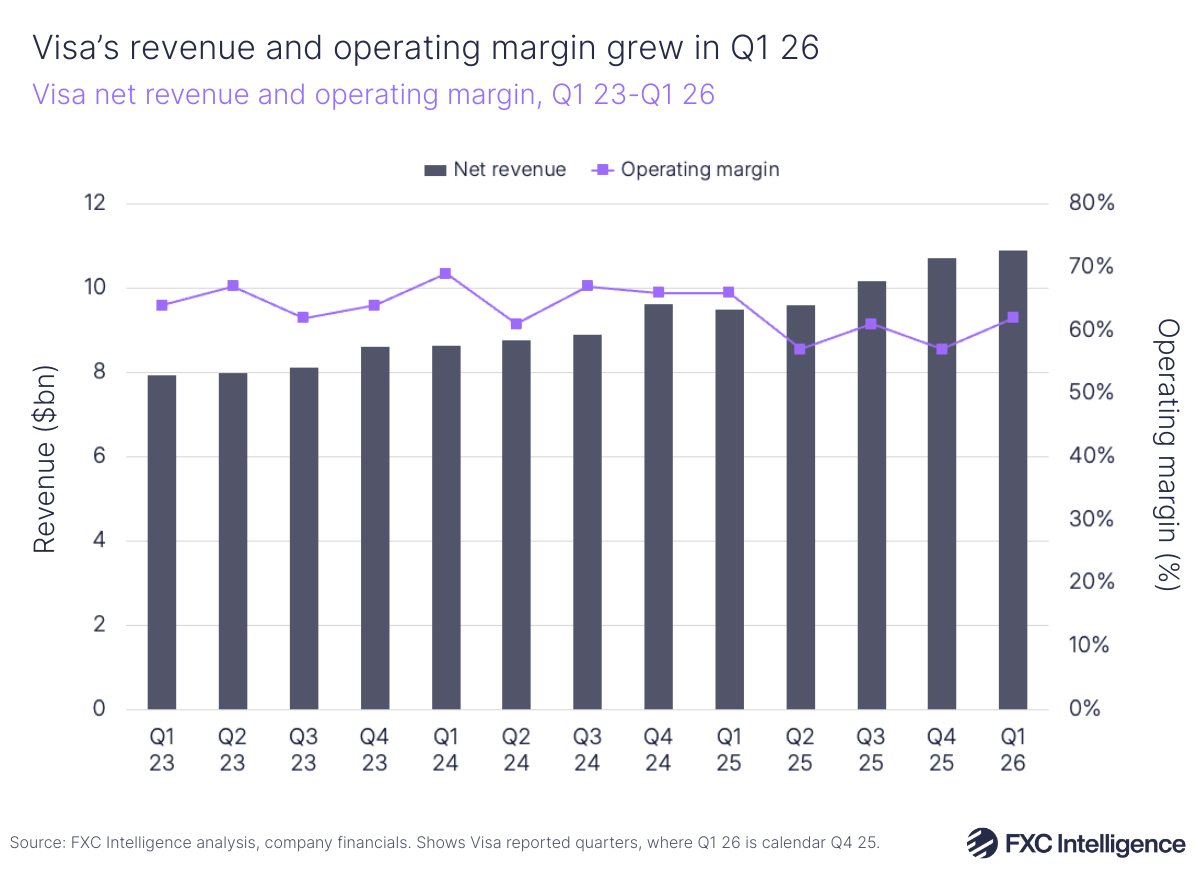
In Visa’s Q1 2026 results (calendar Q4 2025), the company reported a 15% YoY increase (13% on a constant-dollar basis) in net revenue to $10.9bn.
Revenue growth was largely driven by an 8% increase in payments volume and a 12% rise in cross-border volume (11% excluding intra-Europe) on constant dollar terms. During the earnings call, Visa CFO Christopher Suh primarily attributed this faster cross-border volume growth to strong client performance. Processed transactions also grew by 9% to 69.4 billion in Q1.
Visa’s revenue growth came despite a larger than expected 27% YoY increase to the company’s operating expenses, which came as a result of an unexpected increase in marketing services-related expenditure – although this did ultimately support growth in value-added services revenue.
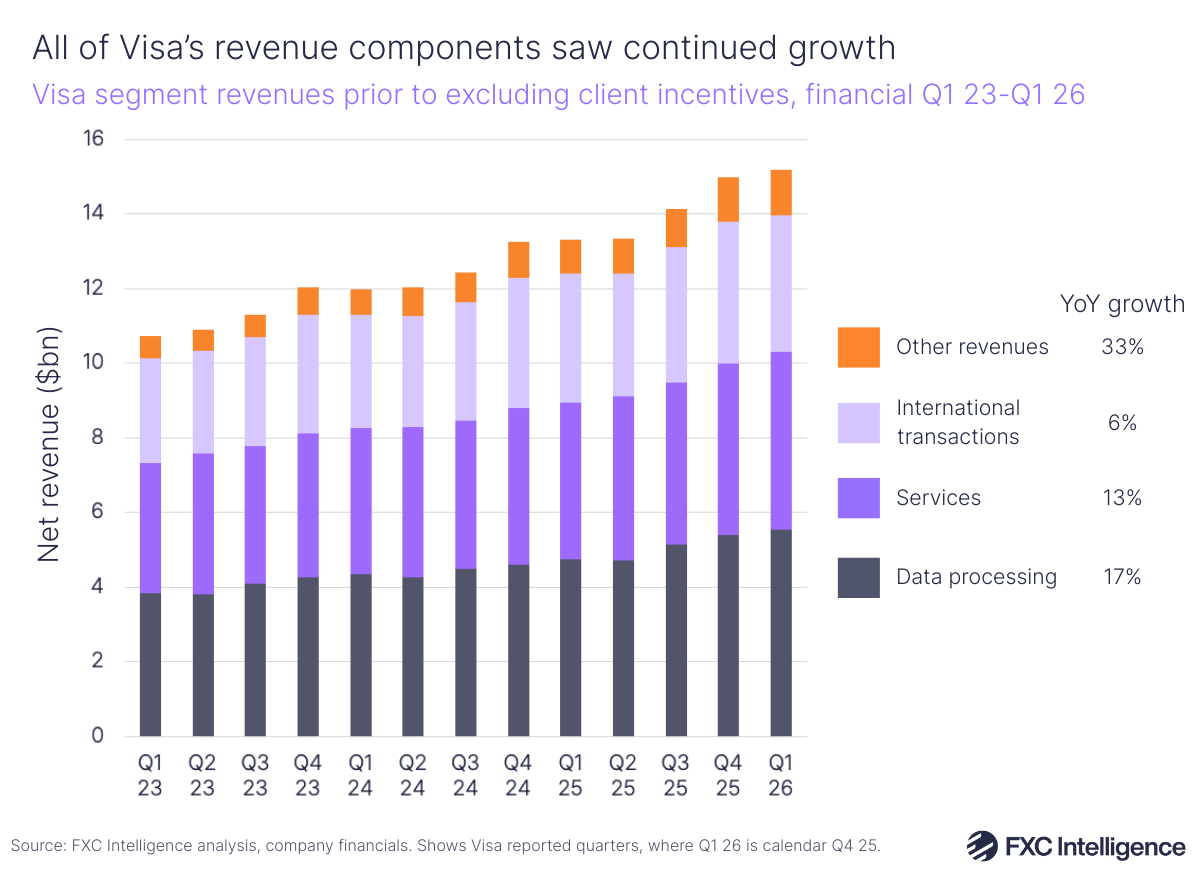
Of Visa’s revenue segments, international transaction revenue saw the slowest YoY growth of 6% to $3.7bn – slower than the 11% growth in cross-border volume growth excluding intra Europe, which is a key driver of this revenue component. This resulted in a 2% decline in international transactions share of overall revenue compared to Q1 2025, falling to 24%.
Data processing revenues continue to make up the largest share of total revenue at 37%, with Suh explaining that 17% growth to $5.5bn in this segment was driven by higher cross-border transaction mix, as well as “strong” value-added services performance. Service revenue, which is driven by fees collected on payment volumes, saw its fastest growth since Q3 2023 (calendar Q2 23) at 13%, rising to $4.8bn – though its share of overall revenue fell slightly to 31%. Meanwhile, other revenues grew the fastest, with 33% growth to $1.2bn, although this represents the smallest share of total revenue at 8%.
Following the strong quarter, Visa maintained its guidance for its full year 2026, projecting low-double-digit YoY growth for the period.
Visa employs stablecoins to drive future growth
Visa Direct, the company’s B2B2X offering, continued to enjoy significant success, with the number of transactions processed through the platform growing 23% YoY to 3.7 billion. Plans to continue this growth trajectory already appear to be underway, after Canada-based payment processor Nuvei expanded its existing Visa Direct agreement and PayPal’s Xoom increased its Visa Direct cross-border reach to more than 60 markets.
Looking to the future, CEO Ryan McInerney says the company is now piloting Visa Direct stablecoin payouts, which would enable businesses based in the US to send payouts to individuals’ stablecoin wallets.
Beyond Visa Direct, stablecoins continue to be an important focus for the payment network. In Q1 26 (calendar Q4 25), the company expanded stablecoin card issuance to nine more countries, seeing coverage surpass 50 countries globally. After recently bolstering its stablecoin settlement capabilities with USDC, the payment giant is looking to create more liquidity for its partners by enabling them to access settlement seven days a week, including when corresponding banking is not available.
During the earnings call, McInerney explained that Visa has seen an increasing number of financial institutions and organisations looking to develop stablecoin strategies. He also touched on efforts to expand its agentic commerce offerings, including partnering with spend management company Ramp to bring agentic payments to its business customers. Mastercard also shared it has plans to enable agentic commerce with more than 100 partners in the future.
Mastercard Q4 2025 earnings results
Mastercard’s net revenue increased 18% YoY (15% on a currency-neutral basis) to $8.8bn in Q4 2025, while operating income rose 25% to $4.9bn – giving an operating margin of 56% for the quarter.
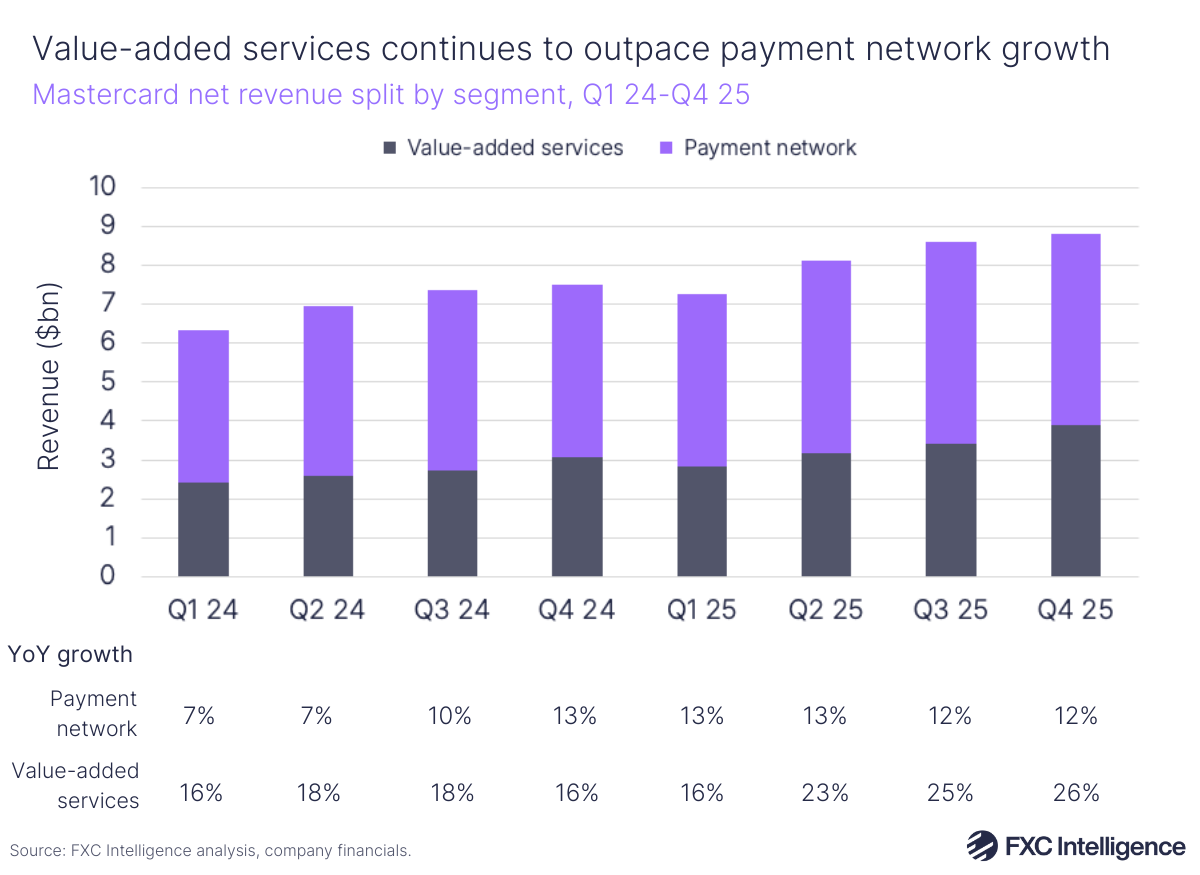
Mastercard reported that its payment network net revenue also increased 12% to $4.9bn, with the company identifying 14% growth in cross-border volume as a key driver behind this. Mastercard explained that both travel and non-travel related cross-border spending grew in Q4.
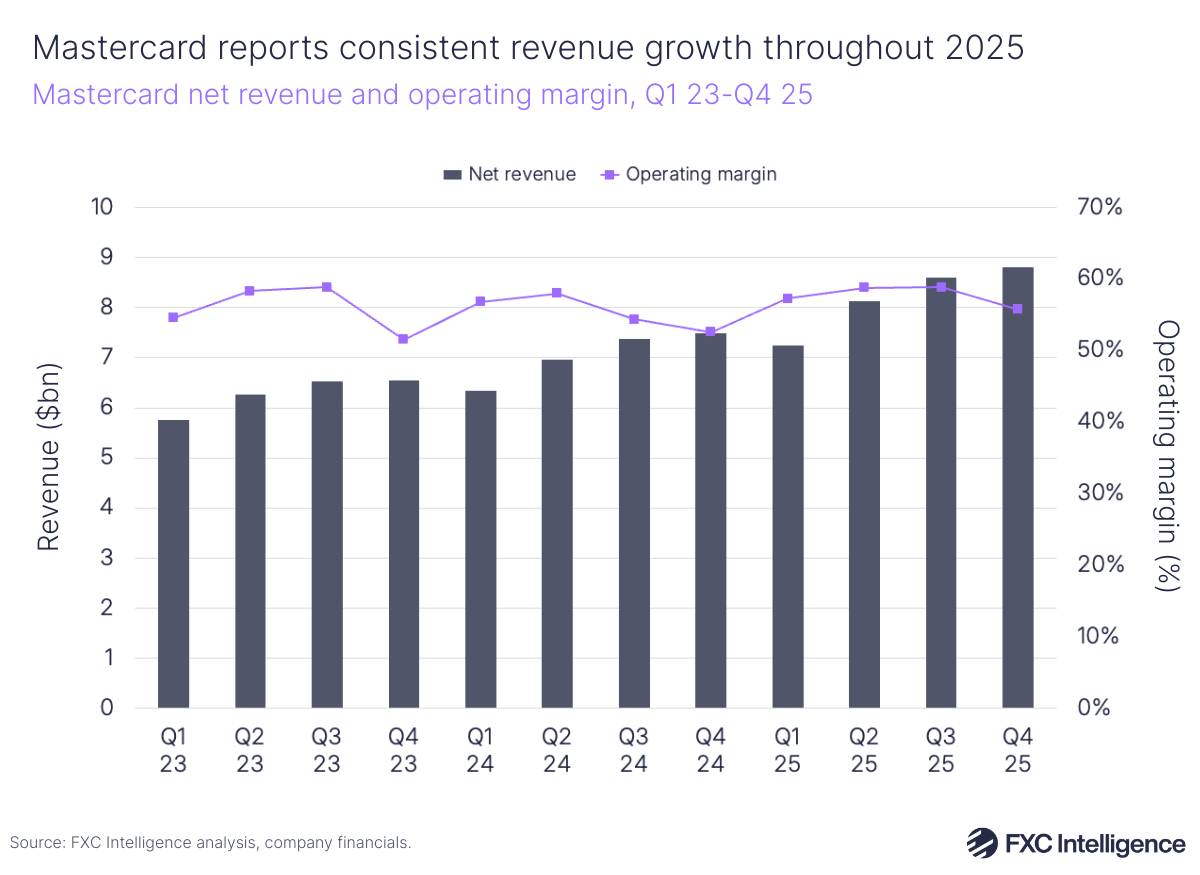
Looking at the full year results, Mastercard’s payment network continues to be the biggest contributor to the company’s revenue, generating a 59% share of revenues in 2025. However, this share has fallen consistently in recent years, as growth in value-added services revenue has outpaced payment network revenue growth. This trend continued in 2025, with payment network revenue growing 12% YoY, while value-added services grew 23% for the same period.
For the full year, cross-border volume grew 15% on a local currency basis, while switched transactions rose 10% and gross dollar volume increased 9%. Mastercard shared good news about its profitability, reporting that its adjusted operating margin for 2025 was 59.2% – a 0.8% increase on 2024.
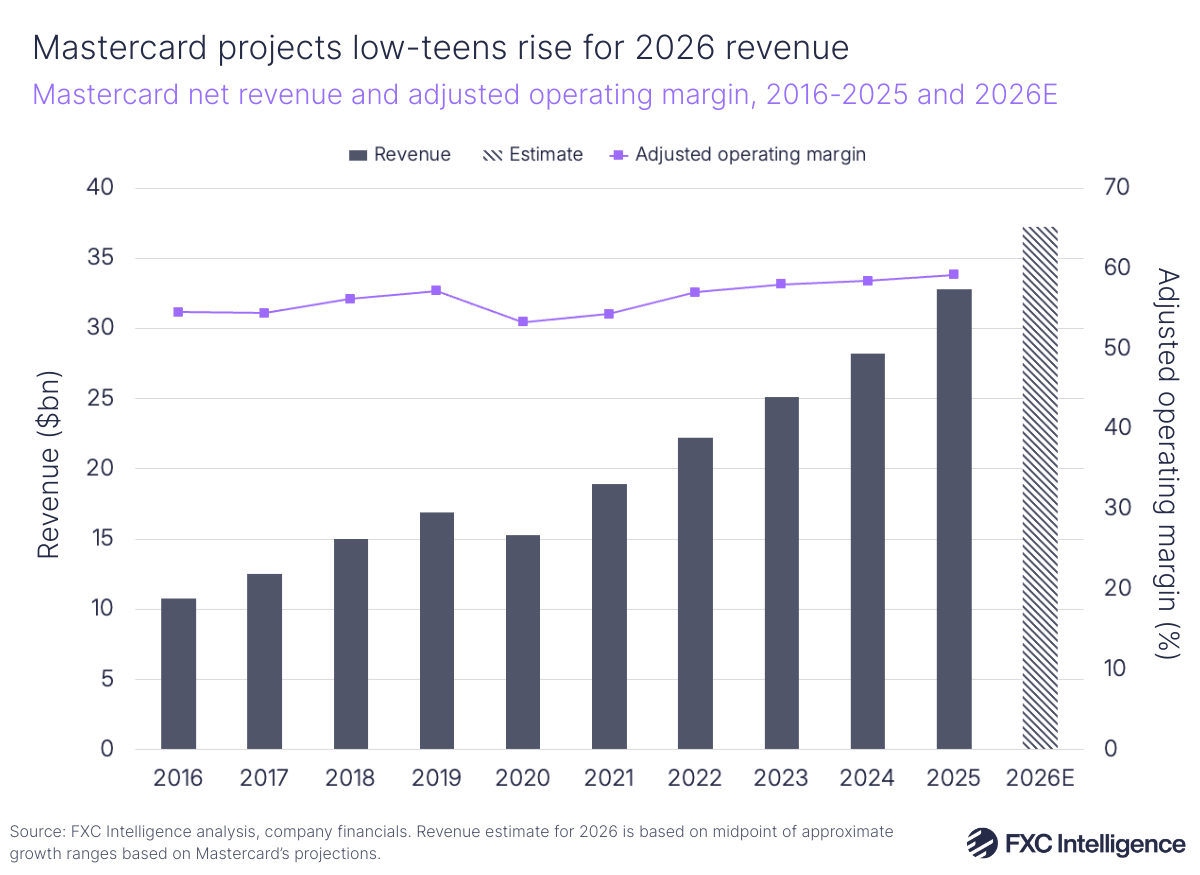
Looking to the future, Mastercard has projected the high end of low double digit growth for net revenue on a currency-neutral basis, which suggests that the payment giant expects slower revenue growth in the coming year than in 2025. CFO Sachin Mehra explained that it expects revenue results in the first half of 2026 to look weaker than in the second half, partly due to the fact that FX volatility drove unusually strong revenue growth early in 2025. Despite this, Mastercard estimates a small tailwind from foreign exchange in the coming year.
Mastercard develops stablecoin and agentic capabilities
The company also shared information about the performance of Mastercard Move, its B2B2X offering. Mastercard CEO Michael Miebach said that the money movement platform now connects to over 17 billion endpoints worldwide, with YoY transaction growth exceeding 35% for both Q4 and the full year.
Like Visa, Mastercard proactively expanded the stablecoin capabilities of its B2B2X platform in Q4. It primarily achieved this in partnership with fintech Thunes, expanding Mastercard Move by enabling payouts to stablecoin wallets, while Miebach also said it is now working with blockchain-based paytech firm Ripple to expand its stablecoin settlement capabilities.
Agentic commerce also remains a key focus for Mastercard, with the company engaging in a number of partnerships worldwide to improve its capabilities and pilot agentic payments. In the last quarter, Mastercard enabled US issuers to participate in its Agent Pay offering, which it launched last year. It also has plans to expand this further in the future across all regions.