Last year saw some significant stablecoin funding rounds, with Circle raising $1.1bn in its IPO in June. Ripple, meanwhile, saw its valuation rise to $40bn after a $500m strategic investment from financial institutions and has since reported to have instituted a share buyback that raises that valuation to $50bn.
While the acquisition of BVNK by Mastercard is big news this week (stay tuned for a deep-dive on that next week), stablecoin funding has continued into 2026. We look at some of the most recent rounds for cross-border payments-focused companies to identify core investment trends across the space.
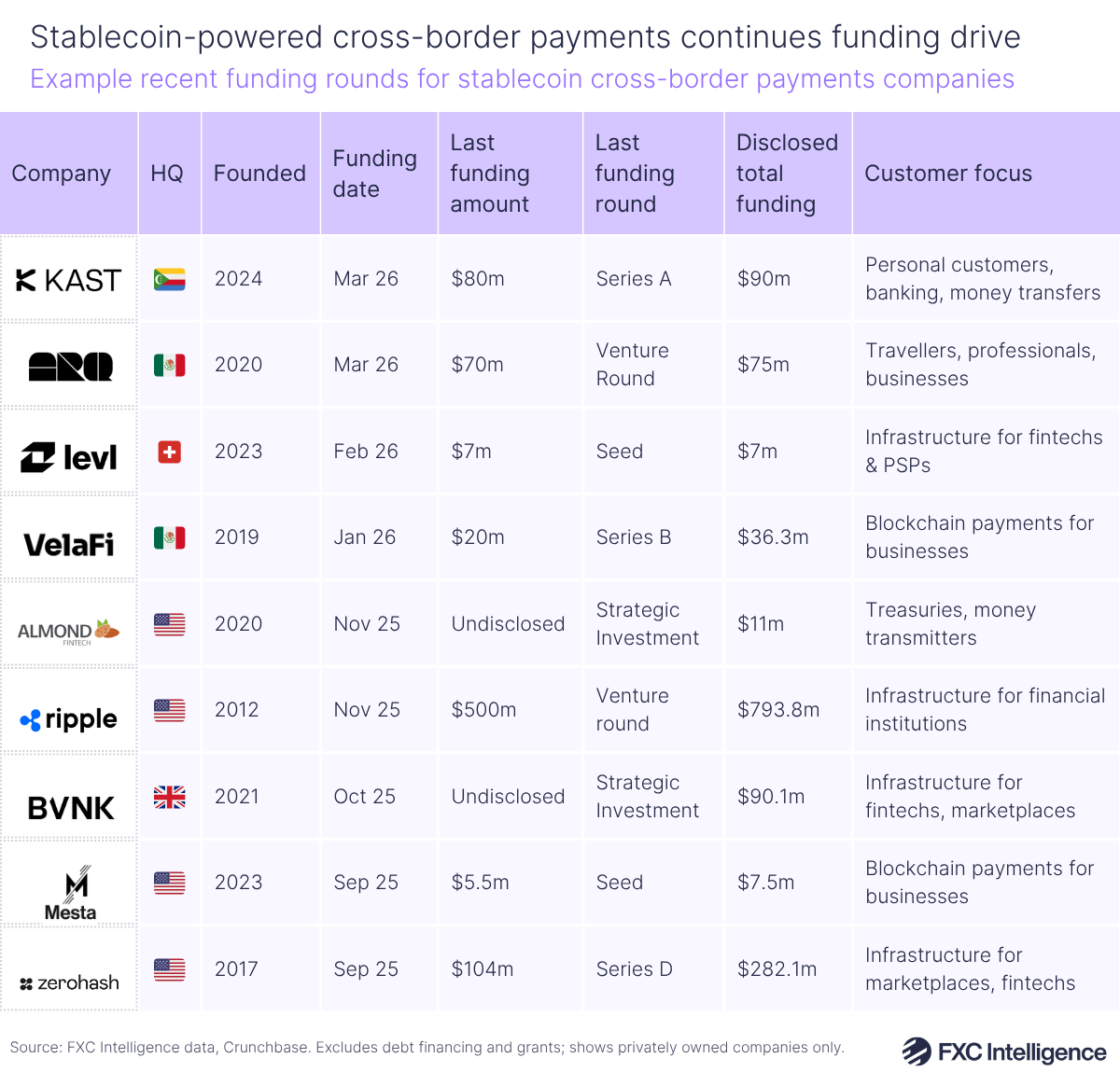
We examined some of the most recent funding rounds over the past six months – excluding debt financing and grants – for companies that are (a) strongly focused on cross-border payments and (b) promoting stablecoins as a core part of the business. This includes larger, more mature providers such as Ripple, as well as a number of stablecoin startups focusing specifically on cross-border.
The majority of the companies receiving investment are focused on B2B payments, with most providing technology that allow businesses to move money internationally using stablecoins and blockchain technology rather than traditional banking rails. A major focus for these companies is on making different use cases – spanning things like international treasury management, global payouts, merchant settlement and cross-border trades – faster and less costly than possible through traditional rails. Investors include venture capital firms and venture funds, but also include banks such as Goldman Sachs and Citi, as well as payment providers with a specific interest in the space such as Visa.
We found that the companies span different specific customer types, though a key target has been selling platforms to fintechs and financial institutions that allow them to add stablecoin payments, wallets and transfers to their capabilities. Another key theme has been enabling merchants to accept payments globally.
While the majority of companies receiving funding are based in the US, some have specific regional focuses. For example, VelaFi provides on/off ramp and global payments services with a specific focus on Latin American businesses. Last week, KAST – a stablecoin payments platform focused on consumers looking to store, earn and spend stablecoins – raised $80m in a Series A funding round, which it will use to expand across Latin America, North America and the Middle East. Also this month, Mexico-based ARQ (which recently rebranded from DolarApp) received a $70m cash injection to help scale up its products, including its app allowing consumers to send money transfers using stablecoins.
Our recent sizing of the stablecoin market highlighted that stablecoin flows represent a significant cross-border opportunity, with a baseline total addressable market of $17.9tn in 2025. With growing investment in the space and new players coming into it all the time, it will be crucial for fintechs and financial institutions to be able to compare companies in the space as they aim to build out capabilities to meet growing demand.