The Philippines, one of the top remittance-receiving countries in the world, saw a slowdown in remittance growth in March. We take a closer look at the data and explore some of the factors behind this change.
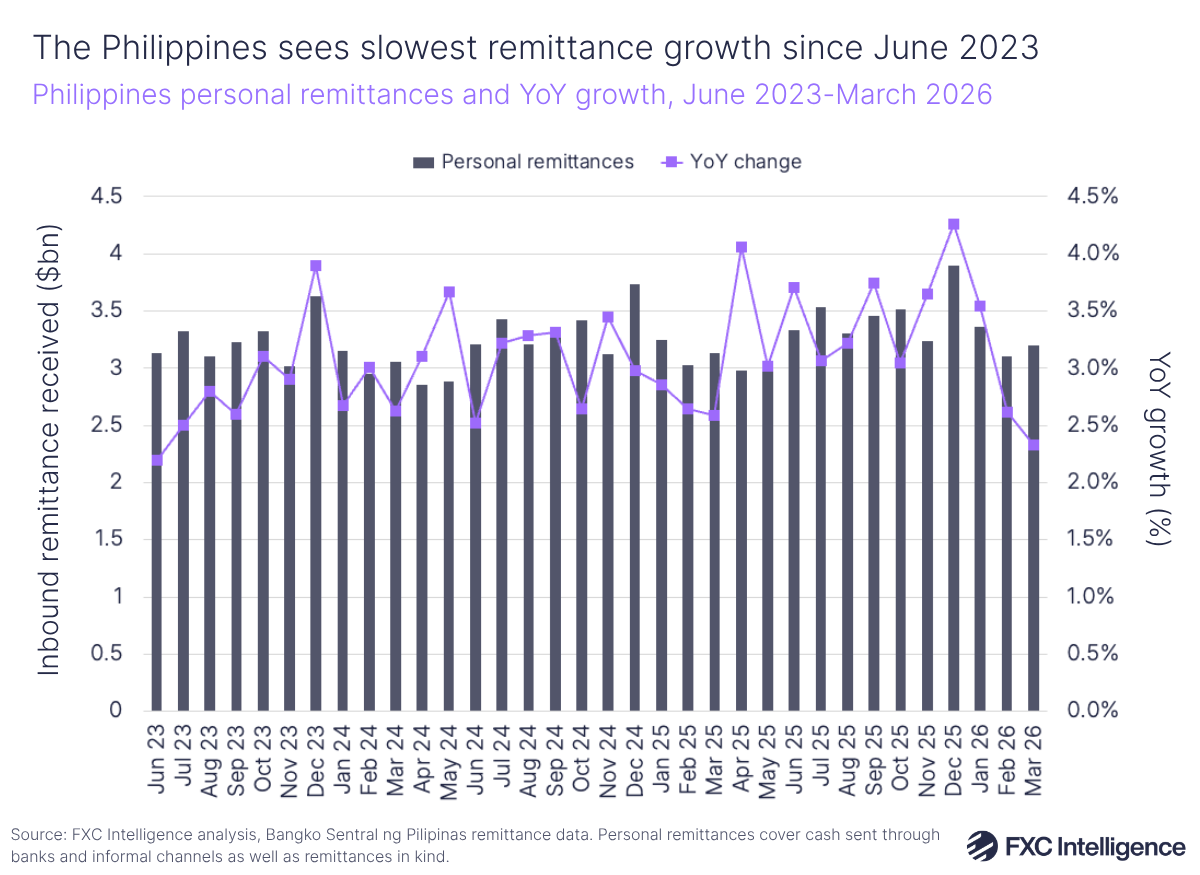
The Philippines’ central bank, Bangko Sentral ng Pilipinas (BSP), regularly shares remittance figures received from overseas Filipino workers. In March 2026, personal remittances – cash sent to the Philippines through both banks and informal channels – grew 2.3% YoY to $3.2bn. However, while remittance volumes have continued to grow over time, this figure represents the slowest growth the Philippines has reported since June 2023 and marks the third consecutive month the Philippines has seen remittance growth slow.
Despite this slowdown, BSP noted in March that it expects cash remittances – cash sent through the banking system – to remain key in helping offset significant economic headwinds, including those caused by ongoing tension in the Middle East. The central bank has projected that remittances will grow by around 3% until the end of 2027, given there are “no signs” of mass repatriation – even as immigration policies tighten in parts of Europe and the US.
Personal remittances grew 2.8% YoY for January to March (Q1) 2026. Although this is slower growth than the central bank’s projection, it was an improvement on the YoY growth seen for the same period in 2025 (2.7%). Personal remittance growth also outpaced cash remittance growth in Q1, with the gap between the two widening by $31m (3% growth) compared to the same period last year. This suggests that Filipinos are increasingly choosing to send their remittances through informal channels.
BSP shared that the US remained the top source of cash remittances to the country in Q1 2026, following 0.8% YoY growth to $3.5bn. This volume significantly outweighs other major remittance sources for the Philippines, including the second-largest remittance sender for this period Singapore, which saw 3% growth to $0.7bn. Saudi Arabia, which sent the third-largest remittance volume between January and March, saw 4% growth to $0.5bn in Q1.
While there has been a slowdown in the growth rate of inbound remittances, 2.8% growth in Q1 2026 alongside strong growth in the country’s largest sources of money suggest that these inflows are remaining resilient, even amidst significant economic pressures on overseas workers’ money.