Asia-Pacific (APAC) remains a key focus for many of the biggest money transfer companies, with the region offering significant potential for future growth, particularly as local businesses increasingly engage with cross-border trade.
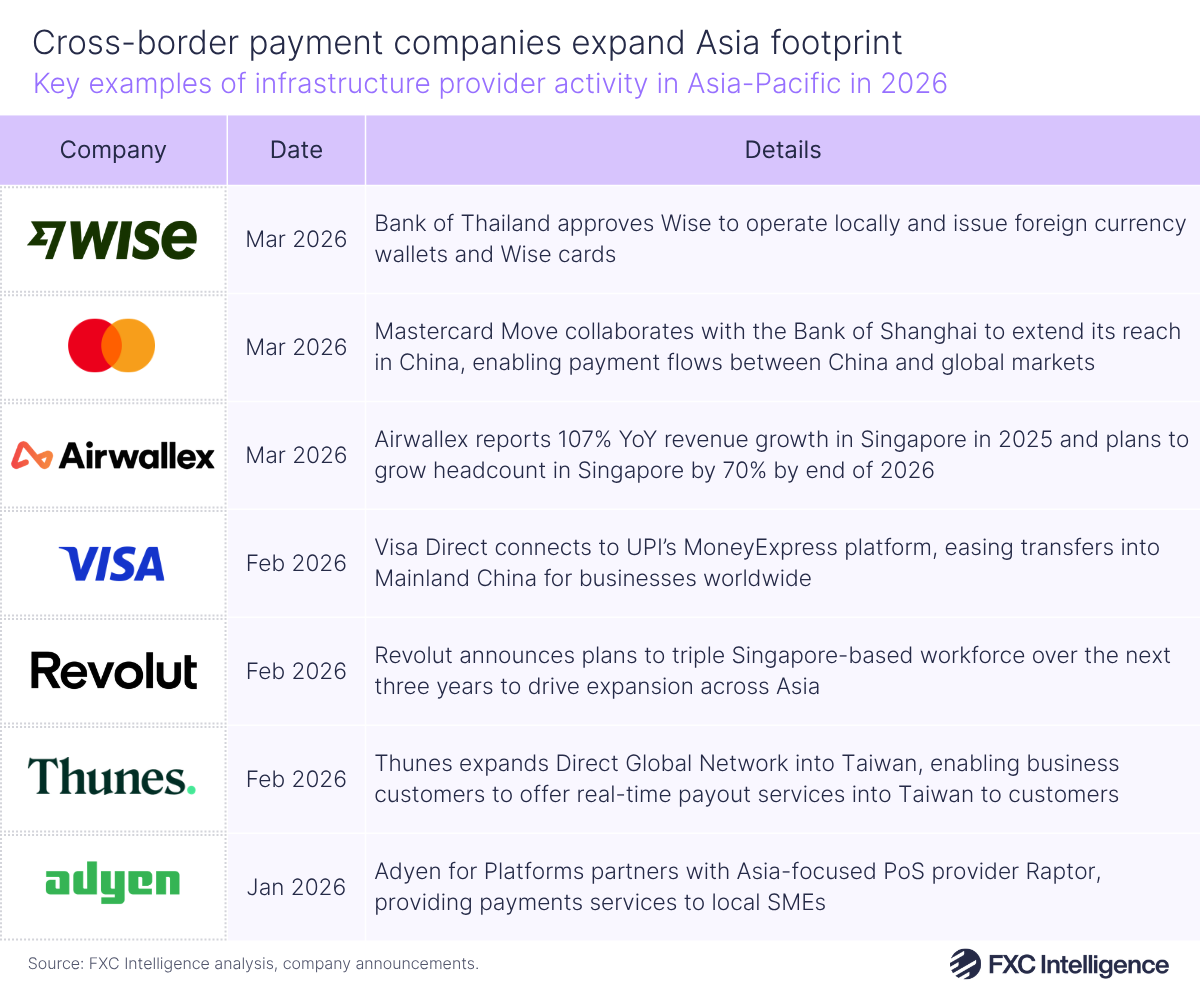
Last week, Wise secured the five licences necessary to issue foreign currency wallets and Wise-branded cards from the Bank of Thailand as part of efforts to expand in APAC. In February, Revolut also outlined plans to triple its workforce in Singapore in the next three years, having already doubled it in 2025.
Meanwhile, several payment infrastructure providers that enable businesses and platforms to move money internationally for business or consumer clients have also been expanding their networks and capabilities in the region.
Airwallex, the financial platform for businesses with dual headquarters in Singapore and San Francisco, recently reported its full-year 2025 results, with its Singapore revenue increasing 107% YoY. The company expanded into Indonesia, Vietnam and South Korea in 2025 and now has plans to build on this growth by increasing the size of its APAC-based workforce by 70% by the end of 2026.
Mastercard Move, the portfolio of money movement capabilities, also recently penned a new partnership with the Bank of Shanghai, expanding its reach in China and enabling bi-directional payment flows between China and other markets worldwide. This move looks to speed up and simplify the process for SMEs paying suppliers based in China, while also reducing the costs of transfers. The payment giant has also launched a suite of new capabilities in Hong Kong for banks and other financial institutions in a move to simplify payment flows to better support SMEs in the region. Mastercard also has plans to expand this offering in other markets within APAC in the future.
Visa Direct has also expanded its reach to Mainland China through a partnership with UnionPay International, enabling businesses to send business-to-consumer payouts to over 95% of UPI debit cardholders in the country – with this connection set to become available in the first half of 2026.
Elsewhere, Thunes has expanded the reach of its Direct Global Network into Taiwan, giving business customers the ability to offer real-time payout services into the country to customers.
These major payment infrastructure providers expanding their reach across APAC is significant as it enables global SMEs to pay Chinese suppliers via local rails, reducing the delays and high fees commonly associated with correspondent banking. This also enables local SMEs to pay vendors or businesses in the likes of Europe or North America using these rails. Looking to the future, it seems payment interoperability both in and out of APAC only looks set to increase further.