
Wise has released its trading update for Q2 2027 (spanning calendar Q3 2026), in which it reported net revenue rose 21% YoY to $739.1m while transaction revenue rose 22% YoY to $561.3m. Though cross-border transfers remain crucial for Wise, it continues to see strong drivers from its card product and other services as it expands its connections abroad.
Wise’s revenue and volume growth in Q2 2027
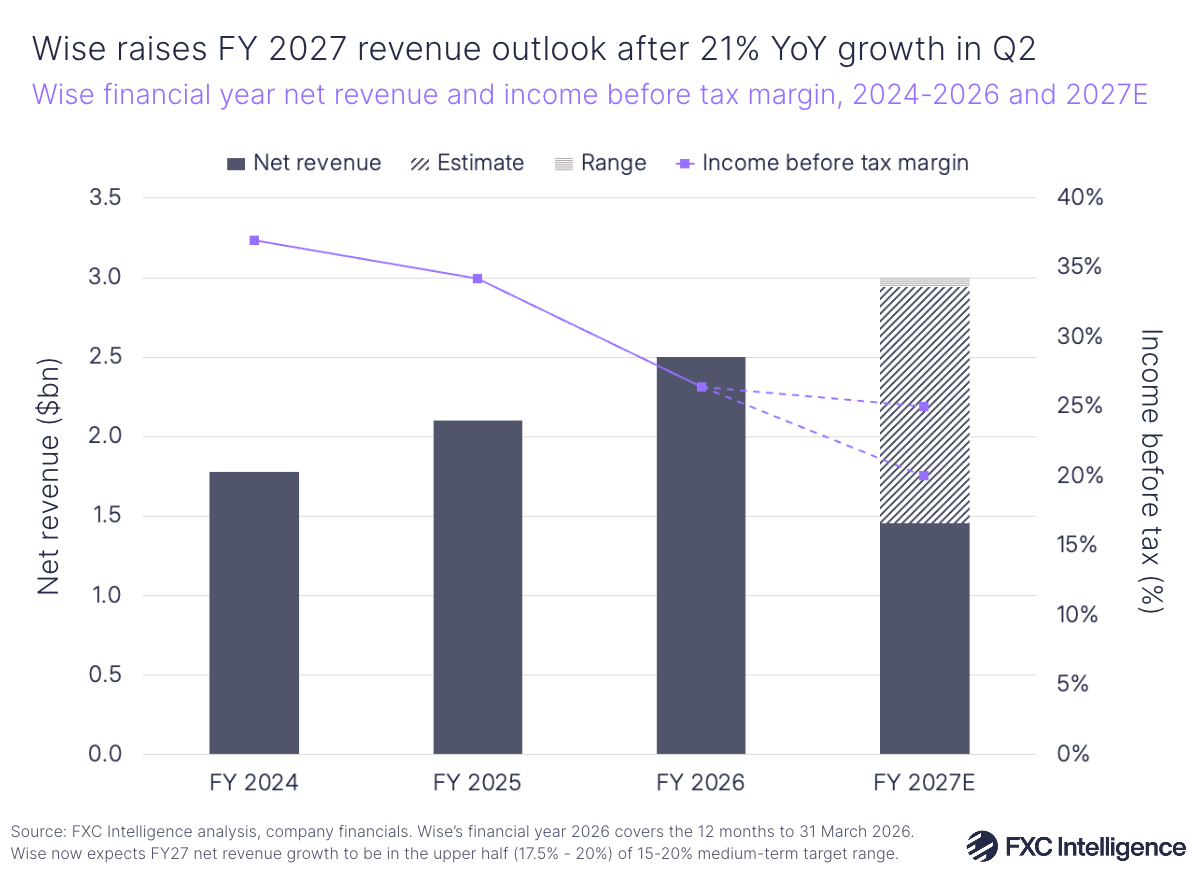
As a result of its Q2 earnings, Wise has now raised its expected results for its FY 2027 (calendar Q2 2026 to Q1 2027), with net revenue in the upper half (17.5-20%) of its 15-20% medium-term target on a constant currency basis. It also projects its income before tax margin – its core profitability metric – to be “around the top” of its 20-25% range in FY 2027.
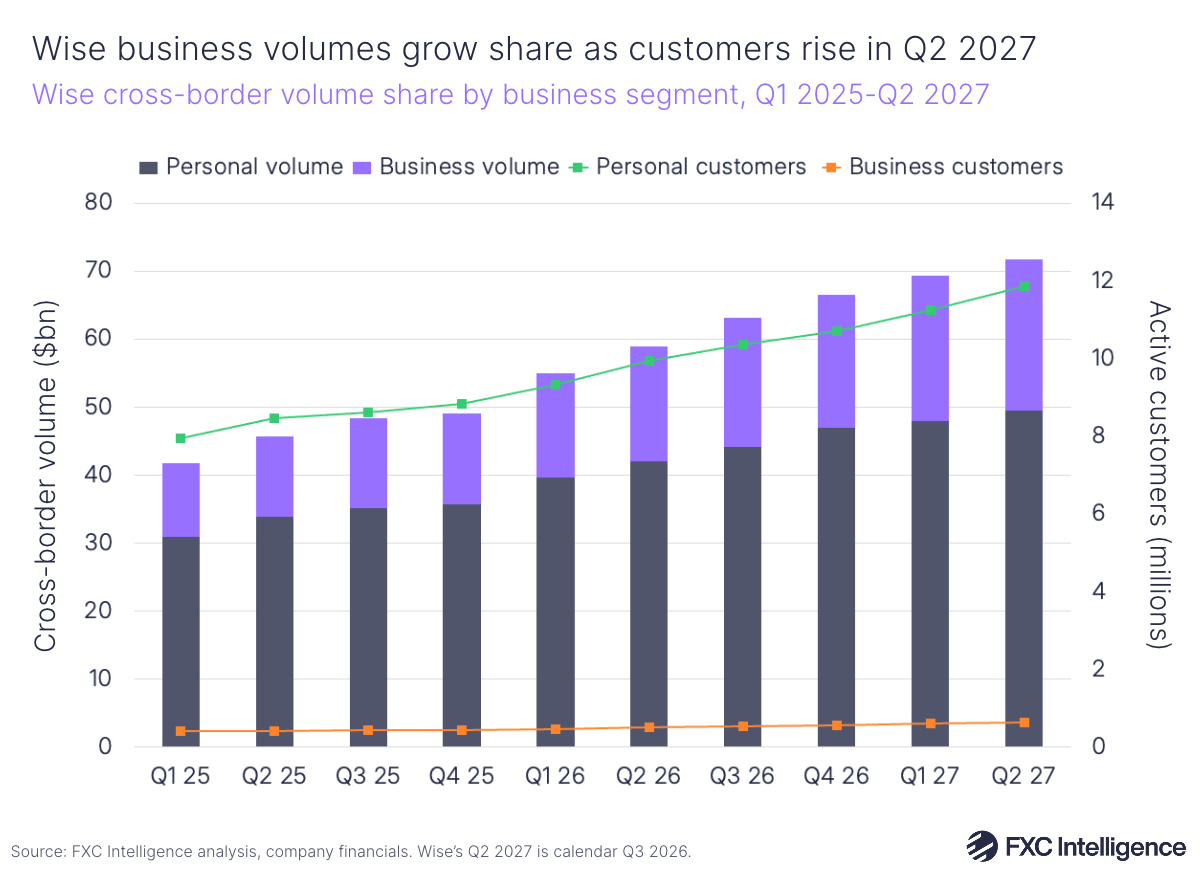
During the quarter, Wise’s quarterly cross-border volume grew 22% YoY to $71.7bn, driven by active customers rising 20% YoY to 12.5 million. Cross-border continues to be driven by strong growth in Wise’s active Personal and Business customers, where the company also continues to see a shift. Personal customers rose by 19% to 11.9 million, driving an 18% rise in Personal cross-border volume to $49.5bn. Meanwhile, the number of Business customers grew faster, rising 26% to 633,000 and driving a 32% volume rise to $22.3bn. Though Business customers account for a much smaller share of Wise’s customers, they now take 31% of the overall volume, up from 30% in Q3 2026 and 26% in Q3 2025.
Wise’s diversifying customer mix
Cross-border revenue has also seen an impact from the company’s continued investment in bringing its pricing down, resulting in its take rate falling 3 bps to 0.49% in Q3 compared to the previous year. Wise aims to continue to reduce its pricing for the next two quarters, though Wise CFO Emmanuel Thomassin clarified this would depend on “investment capacities or efficiency gain”. He also said that pricing decreased by 1 bps from 0.50% in Q1 2027 rather than an expected 2 bps, due to fewer high-volume transactions in the US, which are typically at a lower take rate.
However, aside from cross-border, customers also continue to hold and spend more through Wise, with customer holdings on the platform rising 28% YoY to $43.5bn and card spend volumes rising 30% YoY to $14.3bn.
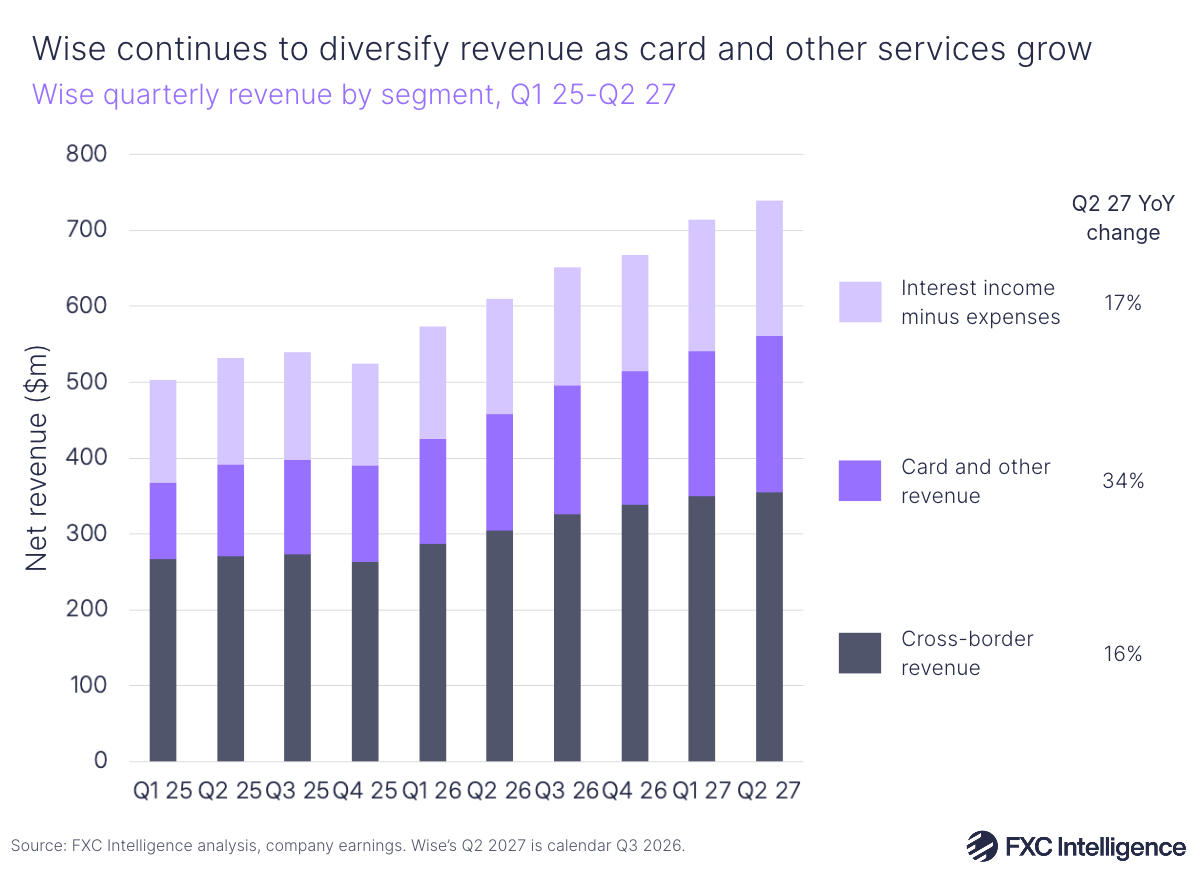
This reflected the continued impact of Wise Account on the company’s revenues, which continues to diversify its mix. Cross-border revenue rose 16% to $355m, while Card and other revenue rose by 34%, pushing its share of Wise’s overall revenue to 52%, up from 50% in the same period last year.
During a call accompanying the update, Thomassin said this was driven by a rise in business card spending in the US as well as significant adoption of the company’s cards in the US and APAC regions. He also mentioned a number of launches that could continue to drive traction, including the company launching Wise Assets in New Zealand, a checking account in Canada, travel cards in Israel and Thailand, as well as new customisable eSIM services for customers.
Another theme covered in the call was how interest income continues to drive Wise’s revenues as customers hold larger balances with Wise. The company accrued $238.2m of interest income, which, minus expenses, saw $178m added to its net revenue total, with this figure up 17% compared to the previous year.
Wise has reflected interest rate increases from the Fed and European Central Bank in its full-year revenue expectations. However, Thomassin maintains that Wise aims to pay much of this interest income back to customers and aims to be able to invest money without being dependent on interest rates. In terms of where it is investing, Wise continues to focus on bringing pricing down, which in turn it hopes will drive scale and efficiency that it can reinvest into its product.
Finally, Thomassin said that Wise Platform – its cross-border payments infrastructure solution for financial institutions – continued to add partners in the quarter, while it has also launched a direct integration with Malaysia’s real-time payment system, bringing its total number of direct connections to nine.
While there was no update on Wise Platform’s revenue share (it accounted for 6% of cross-border volumes last quarter), Thomassin said that take rates for the platform average out at around 40 basis points, compared to 49 basis points for the group. He added that the company will share more detail in its H1 2027 results due in November.